Barsha Chowdhury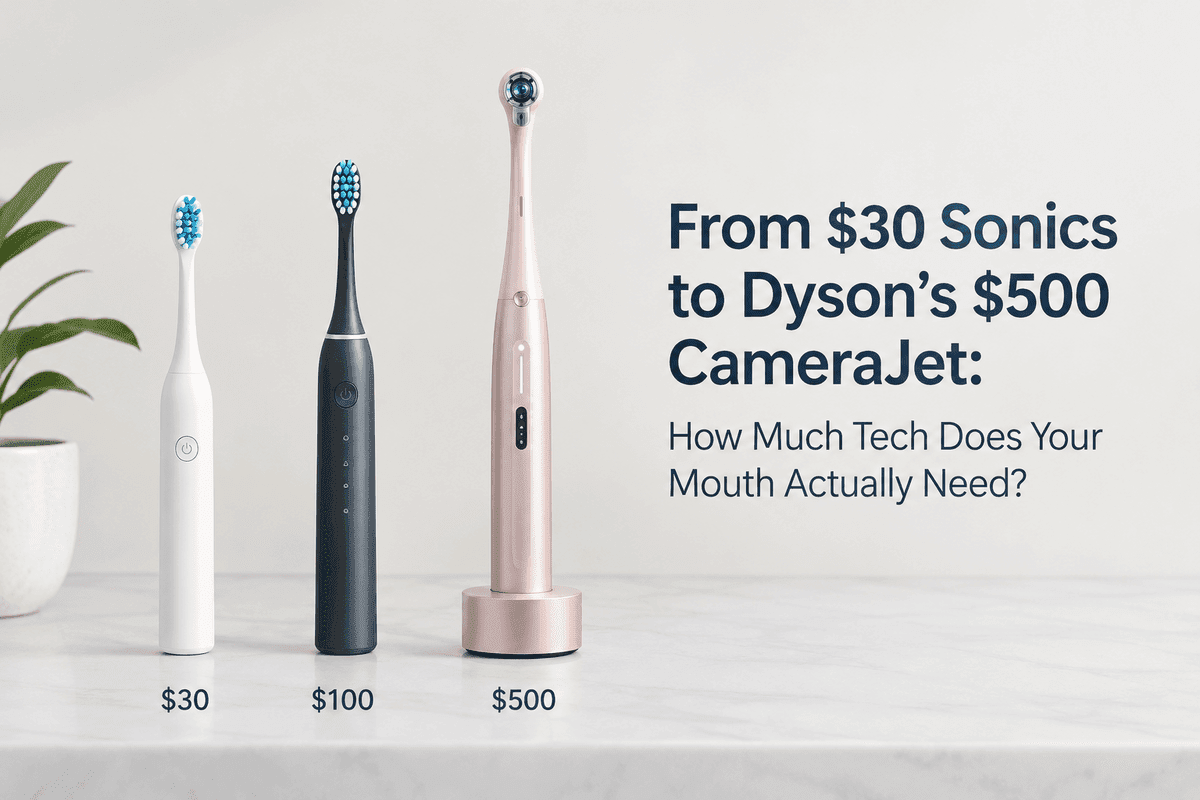
Table of Contents
Dyson’s $500 AI toothbrush has arrived. But do you really need a camera in your mouth? Here is the real ROI on dental tech, from $30 budget picks to luxury AI.
We track our sleep, steps and heart rates, so it was probably only a matter of time before technology took over another daily ritual: brushing our teeth.
That future has arrived. Dyson’s new CameraJet costs $499.99 and combines a 100,000-pixel macro camera, AI-powered Gap Optical Targeting™, live image analysis and targeted liquid flossing. The camera analyzes 28 images per second and can trigger a precision jet within 100 milliseconds, according to Dyson.
But here’s the real question: how much technology does your mouth actually need?
Let’s compare a $30–$60 electric toothbrush with smart mid-range models and Dyson’s $500 flagship to find out where oral-care technology genuinely adds value—and where you’re simply paying for impressive engineering.
Do Electric Toothbrushes Actually Work?
Before worrying about AI and cameras, let’s establish whether an electric toothbrush is worth buying at all.
Research suggests powered toothbrushes can outperform manual brushing for plaque removal and gingivitis. A Cochrane review found reductions of about 21% in plaque and 11% in gingivitis in longer-term comparisons, although the authors noted that the clinical importance of these differences remains uncertain.
The advantage isn’t just the motor.
Electric toothbrushes can also correct common human mistakes:
- 2-minute timers discourage brushing too briefly.
- 30-second pacing helps cover different areas of the mouth.
- Pressure sensors can warn you when you’re brushing too aggressively.
- Smart tracking can highlight areas you repeatedly miss.
In other words, the biggest benefit may be behavioral assistance, not simply faster bristles.
The Electric Toothbrush Price Spectrum
Tier 1: Budget Basics — $30–$60
For most people, this is the sensible starting point.
At this price, you can find electric toothbrushes offering:
- Sonic or oscillating cleaning
- 2-minute timersBasic battery life
- Multiple intensity settings
- Pressure sensing on some models
Verdict
This is where most of the value lives.
If you’re moving from a manual toothbrush, you don’t necessarily need Bluetooth, AI or a camera. A reliable electric toothbrush that encourages consistent, gentle, two-minute brushing can be a substantial upgrade.
Tier 2: The Connected Sweet Spot — $80–$180
Spend more and you begin getting technology designed around personalization.
Depending on the model, features can include:
- Pressure sensors
- Multiple cleaning modesBluetooth connectivity
- Smartphone coaching
- Missed-area trackingTravel charging cases
- Personalized brushing feedback
Verdict
This is the sweet spot for technology enthusiasts.
If you brush too hard, struggle with consistency or genuinely benefit from visual feedback, spending around $100 can make sense.
The key is simple: pay for features that solve your problem, not features that merely sound impressive.
Tier 3: Dyson CameraJet — $499.99
Then there’s the Dyson CameraJet.
This is not simply a smarter electric toothbrush.
It’s an attempt to combine brushing and interdental cleaning into one automated routine.
What You’re Getting
Dyson’s CameraJet includes:
- A 100k-pixel macro camera
- Gap Optical Targeting™AI machine-learning processing
- Analysis of 28 images per second
- Targeted liquid jets
- Variable sonic oscillation
- Three brushing intensities
- RFID-enabled brush heads
- MyDyson app connectivity
Dyson says its conical jet can deliver up to 0.15 ml of liquid between teeth, while the targeted burst can activate in as little as one-tenth of a second.
The most interesting feature isn’t actually the camera.
It’s what the camera does.
What Is Gap Optical Targeting™?
Traditional toothbrushes clean the surfaces their bristles reach. The spaces between teeth are harder to clean, which is why interdental cleaning matters.
Dyson’s Gap Optical Targeting technology uses the camera to detect gaps between teeth. Its machine-learning system identifies, tracks and predicts these gaps, allowing the brush to direct a liquid jet toward them while you brush.
That’s a genuinely different approach to oral care.
Dyson says the system was developed using a machine-learning model trained on 470,000 dental images. However, it’s important to distinguish Dyson’s own product and laboratory claims from independent long-term evidence.
So, is Dyson’s toothbrush worth $500?
For most people, probably not.
But for someone who hates flossing and wants automated interdental cleaning, the value proposition becomes much more interesting
What Tech Are You Actually Paying For?
| Feature Tier | Price Range | Core Tech | Best For |
| Essential | $30–$60 | Sonic/oscillating motor, timer | Anyone upgrading from manual brushing |
| Smart | $80–$180 | Pressure sensor, Bluetooth, tracking | Habit builders and aggressive brushers |
| Ultra-Luxury | $499+ | AI camera, gap detection, precision jet | Tech enthusiasts and people who dislike flossing |
The huge jump from $100 to $500 isn’t simply about a better motor.
You’re paying for automation, sensing, imaging and an integrated flossing system.
That’s impressive but whether it’s worth the premium depends entirely on how much those features change your behavior.
How Much Tech Does Your Mouth Actually Need?
Here’s the easiest decision framework.
The Minimum Viable Tech
For most people, a $40–$60 electric toothbrush with a timer and pressure sensor is enough.You don’t need an app to brush effectively.
You don’t need AI to tell you that you haven’t brushed for two minutes.
And you certainly don’t need a camera if you’re already maintaining a good routine.
When Should You Upgrade?
Consider the $80–$180 category if you:
- Brush too aggressively
- Frequently miss areas
- Struggle with consistency
- Want personalized coaching
- Have braces or other dental appliances
For orthodontic care, however, follow your dentist or orthodontist’s recommendations rather than relying solely on a smart toothbrush.
When Should You Buy the Dyson?
The CameraJet makes the most sense if you:
- Have plenty of disposable income
- Love cutting-edge technology
- Want an all-in-one brushing and interdental-cleaning system
- Consistently avoid traditional flossingValue convenience more than price
Otherwise, your $500 may be better spent elsewhere including on professional dental care.
Dyson CameraJet vs. $30 Sonic: Final Verdict
The Dyson CameraJet is an impressive engineering feat, and its camera-based approach to interdental cleaning is genuinely different from conventional electric toothbrushes. Dyson currently lists it at $499.99.
But the most expensive toothbrush isn’t automatically the best toothbrush for you.
If a $40 electric toothbrush gets you brushing properly twice a day, you’re already addressing the fundamentals.
If a $100 smart toothbrush helps you stop brushing too hard or consistently covers areas you miss, that upgrade can be worthwhile.
And if a $500 AI toothbrush finally convinces you to clean between your teeth every day, perhaps the technology has earned its place.
Frequently Asked Questions
1. Is an electric toothbrush better than a manual toothbrush?
Research suggests powered toothbrushes can provide greater reductions in plaque and gingivitis than manual brushing, although technique and consistency remain extremely important.
2. How much should you spend on an electric toothbrush?
For most people, $30–$60 is a reasonable starting point. Spending around $80–$180 can make sense if you want advanced sensors, tracking or personalized feedback.
3. Is the Dyson CameraJet worth $500?
For most consumers, it’s a luxury rather than a necessity. Its camera-based gap detection and automated liquid flossing are innovative, but a much cheaper electric toothbrush can provide the fundamental benefits of powered brushing.
4. What is Gap Optical Targeting?
Gap Optical Targeting™ is Dyson’s AI-powered system that uses the CameraJet’s 100k-pixel camera to detect and target gaps between teeth for precision liquid flossing.
5. Sonic vs. oscillating toothbrush: which is better?
Both can be effective. Rather than focusing only on motor type, prioritize a toothbrush that you can use consistently, comfortably and correctly.
6. What is the best smart toothbrush for healthier gums?
The best smart toothbrush is the one whose features address your specific habits particularly pressure sensing, timing and coverage guidance. A more expensive toothbrush isn’t automatically healthier.
7. Do I still need to floss with an electric toothbrush?
Unless your dentist recommends otherwise, interdental cleaning remains important. Dyson’s CameraJet is specifically designed to integrate precision liquid flossing into brushing, but traditional floss or other interdental-cleaning methods may still be appropriate depending on your needs.
Get real time update about this category directly on your device, subscribe now.