Suddham Sen
 Pradip S.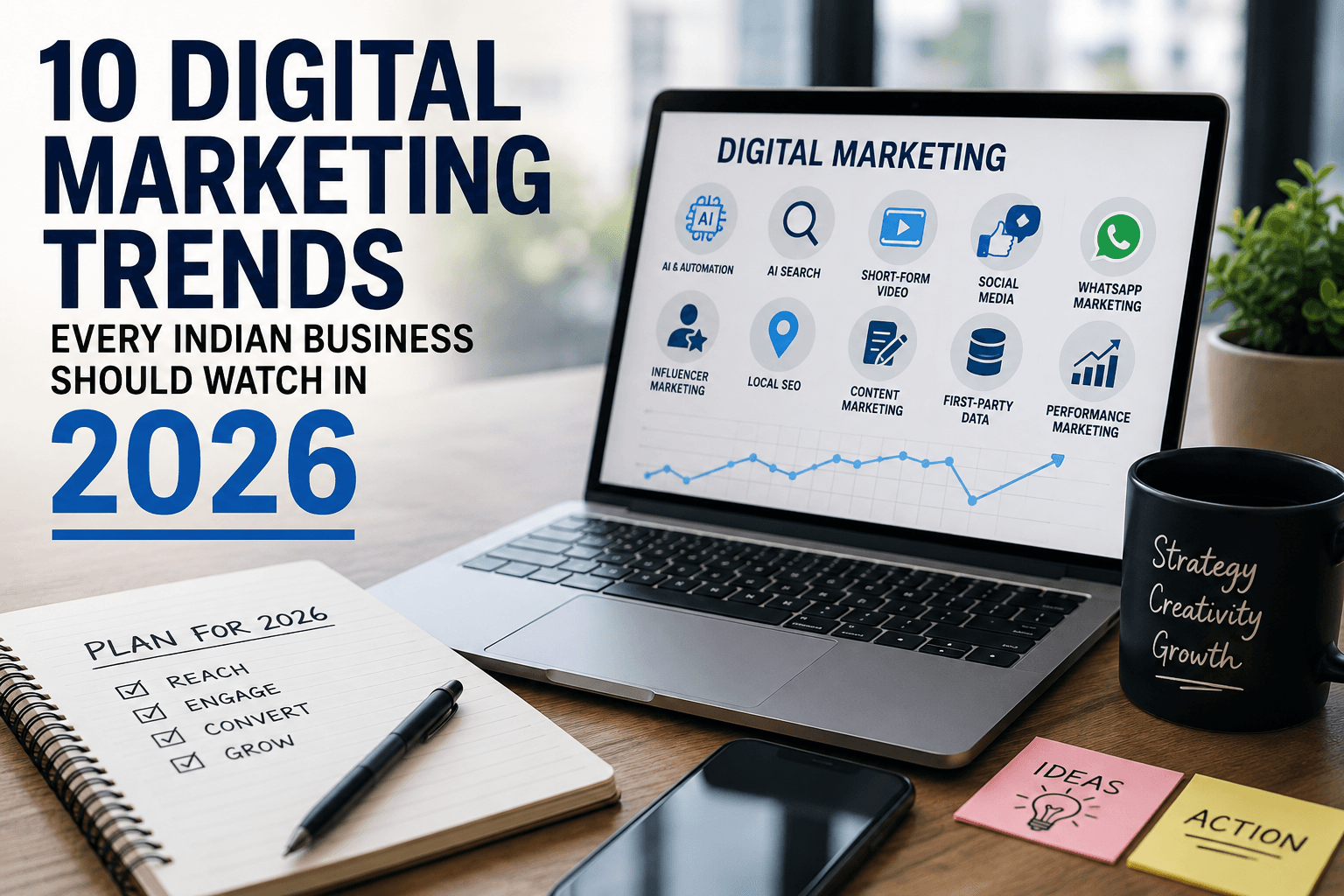
Digital marketing in India has never stood still for very long.
A few years ago, the playbook was relatively straightforward: build a website, rank on Google, run some Meta ads, post regularly on social media and hope the numbers moved in the right direction.
That playbook still works—but it is no longer enough.
In 2026, people are discovering businesses through Google’s AI-powered search experiences, Instagram Reels, creators, WhatsApp conversations, social feeds and increasingly personalised recommendations. The journey from “I’ve never heard of this business” to “I’ll buy from them” is becoming less linear.
Google has continued expanding AI-powered experiences in Search, while Meta’s latest India research points to a shopping journey increasingly shaped by AI, short-form video, creators and messaging. (blog.google)
For Indian businesses, this doesn’t mean throwing away everything that worked before.
It means becoming better at connecting the pieces.
Here are 10 digital marketing trends worth paying attention to in 2026—and, more importantly, what they actually mean for your business.
Table of Contents
1. AI Is Moving From a Marketing Tool to a Marketing Layer
AI-generated captions and blog posts aren’t exactly breaking news anymore.
The more interesting shift is happening underneath the surface.
Businesses are beginning to use AI across the marketing process—from understanding customer behaviour and analysing campaigns to personalising communication, assisting customer service and speeding up creative production.
The important distinction is that AI shouldn’t replace marketing strategy.
It should make good marketing easier to execute.
For example, an agency might use AI to analyse hundreds of search queries and identify patterns. A sales team might use it to summarise customer conversations and identify common objections. A content team might use it to turn one detailed article into a series of social posts, videos and email ideas.
The human still decides:
- What the brand should say
- Who it should say it to
- What makes the business different
- What claims can actually be supported
- What the customer needs to hear
That distinction will become increasingly important as AI-generated content becomes easier for everyone to produce.
The opportunity: Use AI to increase the speed of execution without making your brand sound like everyone else’s.
2. Google Search Is Becoming an AI Experience
If your SEO strategy still revolves entirely around getting a page into the traditional blue-link results, 2026 is a good time to broaden the strategy.
Google has been expanding AI Overviews and AI Mode, allowing users to ask longer, more conversational questions and explore follow-up questions directly within Search. Google says AI Mode had surpassed one billion monthly users by May 2026. (blog.google)
That changes the question businesses need to ask.
It is no longer simply:
“How do I rank #1 for this keyword?”
It is increasingly:
“How do I become a source that search systems can understand, trust and reference?”
This is where terms such as GEO (Generative Engine Optimization) and AEO (Answer Engine Optimization) enter the conversation.
But don’t mistake this for the death of SEO.
Technical SEO, crawlability, useful content, authority, internal linking and strong pages still matter. In fact, they’re part of the foundation.
The difference is that your content now needs to work for both traditional search results and AI-mediated discovery.
The opportunity: Create genuinely useful pages that answer real questions clearly, demonstrate expertise and make your business easy for search systems to understand.
3. Short-Form Video Is Becoming a Discovery Engine
Short-form video isn’t a “new trend” anymore.
That’s precisely why businesses should stop treating it like one.
Reels, Shorts and other vertical video formats have become a normal part of how people discover products, services, businesses and ideas.
Meta’s 2026 research on India describes a shift toward a scroll-led discovery ecosystem, with AI, Reels, creators and conversational messaging playing increasingly important roles in how people move from discovery to purchase. (About Facebook)
For businesses, the lesson isn’t:
“Post more Reels.”
It’s:
“Give people a reason to stop scrolling.”
That might be:
- A useful tip
- A before-and-after
- A customer problem
- A myth worth challenging
- A demonstration
- A founder’s opinion
- A product comparison
- A behind-the-scenes look
- A quick answer to a frequently asked question
And importantly, not every video needs to look like an advertisement.
Sometimes the most effective content is simply a knowledgeable person explaining something properly.
The opportunity: Build short-form video around customer questions and expertise rather than endlessly producing promotional creatives.
4. Creators Are Becoming Part of the Sales Funnel
Influencer marketing used to be largely associated with celebrity endorsements.
That model still exists, but India’s creator ecosystem has become much broader.
A 2025 BCG study estimated that India had more than 2–2.5 million monetised content creators, with creators influencing hundreds of billions of dollars in consumer spending. The report projects creator-influenced consumption could exceed $1 trillion by 2030. (Boston Consulting Group)
The interesting part for smaller businesses isn’t necessarily the size of that number.
It’s the shift in who can influence a purchase.
A niche creator with a highly relevant audience can sometimes be far more useful to a business than a celebrity with millions of followers but little connection to the product.
Think:
- A fitness coach for a nutrition brand
- A finance creator for a fintech product
- A local food creator for a restaurant
- A beauty creator for a skincare brand
- An industry expert for a B2B service
The creator doesn’t just provide reach.
They can provide context and credibility.
The opportunity: Look beyond follower count. Evaluate audience relevance, content quality, engagement, trust and whether the creator’s audience actually resembles your customer.
5. WhatsApp Is Becoming More Than a Customer Support Channel
For many Indian businesses, WhatsApp is already where customers ask questions.
What’s changing is what businesses can do with those conversations.
In May 2026, Meta introduced Business AI on WhatsApp for small businesses in India, allowing eligible businesses to use AI to answer questions, recommend products, capture leads and book appointments. Meta also said the feature is available in India’s native languages, with UPI payment functionality announced as an upcoming capability. (About Facebook)
That points toward a much broader role for messaging.
Imagine a customer seeing your Instagram post, clicking through to WhatsApp, asking a question, receiving product information and then speaking to a salesperson—all within one connected journey.
That’s very different from:
“DM us for details.”
For service businesses, WhatsApp can also become part of the lead-management process:
Ad → WhatsApp → Qualification → Consultation → Follow-up → Conversion
The opportunity: Treat WhatsApp as part of your conversion infrastructure—not simply another place to send promotional messages.
6. Regional and Multilingual Marketing Will Matter More
India isn’t one audience.
That’s obvious, but digital marketing strategies don’t always behave as though it is.
A campaign that works in Mumbai may not communicate the same way in Lucknow, Bengaluru, Chennai or Guwahati.
And this isn’t simply about translating English content into another language.
It’s about understanding:
- Local expressions
- Search behaviour
- Cultural context
- Buying motivations
- Regional creators
- Local festivals
- Language preferences
Even Google’s rollout of AI Overviews in India has included English and Hindi experiences, reflecting the importance of India’s multilingual search environment. (blog.google)
For many businesses, this creates an interesting SEO opportunity too.
Instead of competing only for highly competitive English-language terms, businesses can build genuinely useful content around relevant regional-language searches.
The opportunity: Don’t ask, “How do we translate our website?”
Ask:
“How does our customer actually search, speak and make decisions?”
That’s a much better starting point.
7. Content Marketing Is Moving From “More” to “More Useful”
Here’s a trend I hope businesses take seriously.
The internet doesn’t need another 1,000-word article explaining what digital marketing is.
AI has made producing generic content incredibly easy.
That means generic content is becoming less valuable as a differentiator.
The businesses that stand out will be the ones that bring something difficult to manufacture:
- First-hand experience
- Original research
- Strong opinions
- Real examples
- Case studies
- Expert commentary
- Proprietary data
- Detailed comparisons
- Useful tools and resources
In other words, content needs a reason to exist.
A good content strategy in 2026 isn’t:
“We need four blogs this month.”
It is:
“What questions are our customers asking, and what can we explain better than everyone else?”
That shift is particularly important for SEO.
A useful article can rank, attract backlinks, support other pages and help a potential customer understand your expertise.
A generic article may simply become another page nobody reads.
The opportunity: Publish fewer pieces if necessary—but make each one substantially more useful.
8. First-Party Data and Customer Relationships Are Becoming More Valuable
There is a simple problem with building your entire marketing strategy on rented platforms:
You don’t control the platform.
Your Instagram reach can change.
Advertising costs can change.
Algorithms can change.
Search behaviour can change.
That’s why businesses are putting greater emphasis on audiences and data they can build relationships with directly.
Depending on the business, that might include:
- Email subscribers
- WhatsApp contacts
- Customer databases
- CRM data
- Purchase history
- Website interactions
- Loyalty programmes
- Existing customers
The goal isn’t to collect as much data as possible.
It’s to collect useful data responsibly and with appropriate consent, then use it to provide a better customer experience.
India’s data-protection framework also makes responsible handling of personal data increasingly important for businesses. The Digital Personal Data Protection Act establishes requirements around the processing and protection of digital personal data, with implementation continuing to develop. (The Times of India)
The opportunity: Build an audience you can communicate with directly rather than depending entirely on whatever platform algorithm happens to be favourable this month.
9. Local SEO Is Still One of the Most Practical Growth Channels
AI may be changing search.
It hasn’t eliminated the need for local businesses to be found.
If someone searches:
“dentist near me”
“best interior designer in Bangalore”
“digital marketing agency in Mumbai”
“cafes near me”
the intent is very different from someone casually reading a blog.
They’re looking for a business.
That’s why local SEO remains particularly valuable for businesses serving a specific geography.
The fundamentals still matter:
- Google Business Profile
- Accurate business information
- Reviews
- Location pages
- Localised website content
- Consistent business information
- Relevant local links and mentions
- Useful location-specific content
And there’s another reason to take this seriously in the AI era.
The more consistent your business information is across trusted sources, the easier it becomes for systems—and customers—to understand who you are, what you do and where you operate.
The opportunity: If your business serves a specific city, region or neighbourhood, don’t treat local SEO as a smaller version of national SEO. Build a strategy specifically around local intent.
10. Marketing Measurement Is Shifting From “Clicks” to the Full Customer Journey
This might be the least glamorous trend on the list.
It might also save businesses the most money.
A campaign generating 50,000 impressions sounds impressive.
A campaign generating 500 leads sounds better.
But what if 450 of those leads are completely irrelevant?
That’s why businesses need to look beyond surface-level metrics.
Depending on your business model, useful metrics might include:
Awareness
- Reach
- Impressions
- Video views
- Branded searches
Engagement
- Engagement rate
- Time on page
- Content interactions
- Returning visitors
Acquisition
- Leads
- Cost per lead
- Organic traffic
- Search visibility
Business outcomes
- Qualified leads
- Sales
- Customer acquisition cost
- Revenue
- Repeat purchases
- Customer lifetime value
This is particularly important as marketing becomes fragmented across Search, AI, social media, creators, messaging and other channels.
The question shouldn’t simply be:
“Which channel got the click?”
It should be:
“Which combination of channels helped create the customer?”
So, What Should Indian Businesses Actually Do About These Trends?
Reading ten trends is easy.
Trying to implement all ten next Monday is a terrible idea.
Most businesses don’t need to be everywhere.
They need to figure out where their customers are actually discovering, evaluating and buying from them.
For one business, that might mean investing heavily in SEO and building content around high-intent searches.
For another, it might mean Reels, creators and WhatsApp.
For a local service business, Google Business Profile and local SEO might generate considerably more value than spending months building a massive social media following.
And for an e-commerce brand, the combination of short-form video, creators, paid media, AI-assisted discovery and conversational commerce could be much more relevant.
The real trend in 2026 isn’t one particular platform.
It’s the convergence of channels.
Search is becoming more conversational.
Social is becoming more shoppable.
Messaging is becoming more transactional.
AI is becoming embedded across the marketing stack.
And customers are moving between all of these without caring which department inside your company owns each channel.
Your marketing strategy needs to reflect that reality.
Final Thoughts
The biggest mistake businesses can make in 2026 isn’t ignoring AI.
It’s chasing every new piece of technology without fixing the fundamentals.
A business with a confusing website doesn’t become a great business because it uses AI.
A weak offer doesn’t become compelling because it has a Reel.
Poor customer service doesn’t disappear because WhatsApp has automation.
And publishing 100 AI-generated articles doesn’t automatically create authority.
The businesses that win will be the ones that combine good fundamentals with better technology.
Build a website people can actually use.
Create content worth finding.
Make your brand easy to understand.
Show up where your customers spend their time.
Use AI where it genuinely improves the process.
Build relationships you don’t completely depend on a platform to maintain.
And, above all, keep measuring what actually contributes to the business.
Because in 2026, digital marketing isn’t becoming less human.
It’s becoming much harder to fake being useful.
Get real time update about this category directly on your device, subscribe now.