Barsha Chowdhury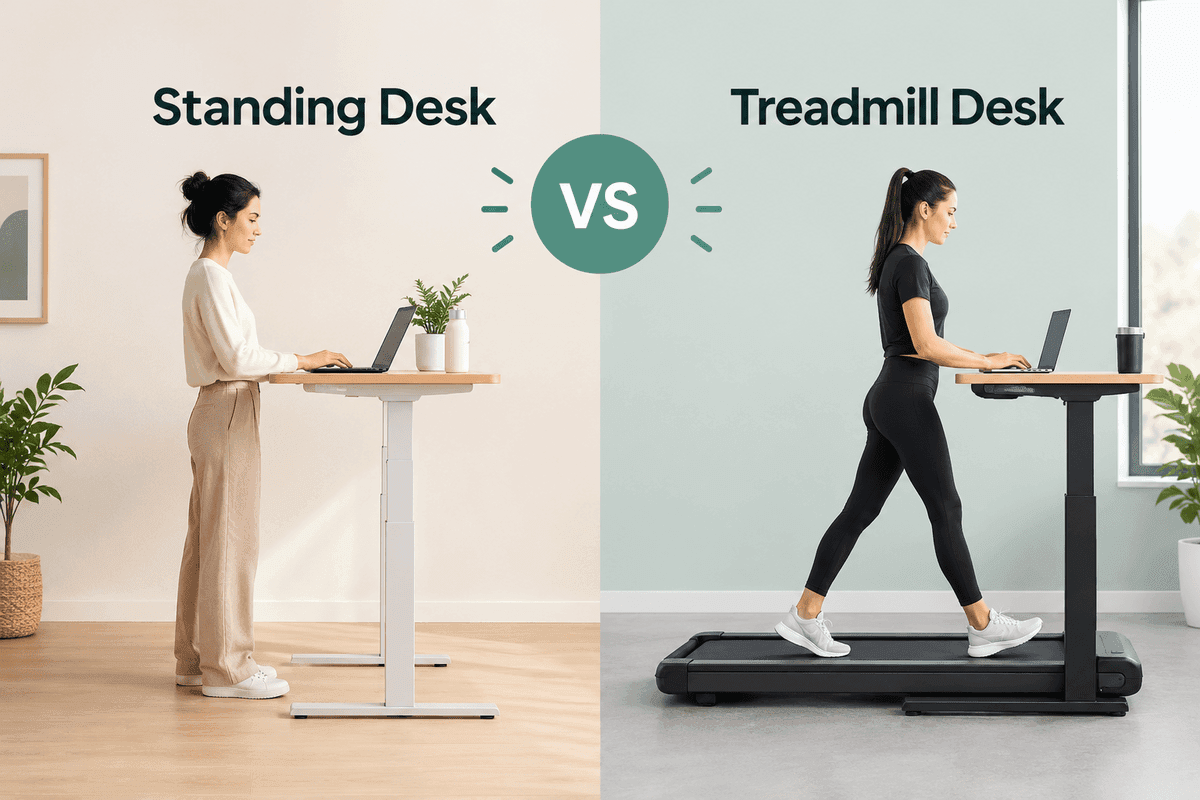
Table of Contents
Sitting at a desk for hours can leave you feeling stiff, inactive, and tired, even when you exercise regularly. Choosing between a standing desk vs treadmill desk can make your workday more active, but which option actually offers greater health benefits? This guide compares both options to help you choose the right setup. We’ll look at their health effects, benefits, risks, calorie expenditure, productivity, and suitability for different work styles.
Standing Desk vs Treadmill Desk: What’s the Difference?
Both desks are designed to reduce the amount of time you spend sitting, but they work in different ways.
A standing desk allows you to work while upright, usually with an adjustable-height surface that lets you alternate between sitting and standing. A treadmill desk combines a walking surface with a workstation, allowing you to walk slowly while completing tasks.
The main difference is movement. Standing changes your posture and reduces sitting, while a treadmill desk adds low-intensity walking to your working day.
Research comparing active workstations suggests that treadmill workstations can produce greater movement and energy expenditure than standing workstations.
Standing Desk Health Benefits
Standing desks have become popular as people look for practical ways to interrupt a sedentary lifestyle.
1. Helps Reduce Sitting Time
One of the biggest standing desk benefits is simply spending less time seated. Alternating between sitting and standing can make your workday less sedentary without requiring a separate workout session.
However, standing all day isn’t necessarily better. The goal should be changing positions regularly, rather than replacing eight hours of sitting with eight hours of standing.
2. May Support Better Movement
A standing workstation makes it easier to shift your weight, stretch, walk around, or take short movement breaks throughout the day.
For an office worker, these small changes can contribute to a more active workstation routine.
3. Easy to Use
Standing desks are generally easier to incorporate into normal office tasks. You can use them while writing, attending video meetings, reading documents, or browsing the internet.
This makes them a practical option for people who find walking while working distracting.
Standing Desk Risks and Disadvantages
Standing desks are not completely risk-free.
Standing for prolonged periods can contribute to discomfort in the feet, legs, and lower back, particularly if the workstation isn’t adjusted correctly. Poor monitor height or keyboard positioning can also create ergonomic problems.
Common standing desk disadvantages include:
- Leg and foot fatigue
- Lower-back discomfort
- Poor posture if the desk is incorrectly adjusted
- Difficulty standing continuously for long periods
- Limited increase in energy expenditure compared with walking
The solution is simple: alternate between sitting, standing, and walking rather than treating standing as a replacement for every other form of movement.
Treadmill Desk Health Benefits
A treadmill desk takes the concept of an active workstation further by allowing you to walk slowly while completing suitable work tasks.
1. Increases Energy Expenditure
One of the most interesting treadmill desk health benefits is increased energy expenditure compared with sitting.
A 2021 systematic review and meta-analysis of 13 studies involving 351 participants found that treadmill-desk use increased energy expenditure by about 105 kcal per hour compared with sitting in laboratory studies. The researchers also found a reduction in sitting time in workplace studies.
That doesn’t mean everyone will burn exactly 105 calories per hour. The actual amount depends on walking speed, body size, duration, and other factors.
2. Helps Break Up Sedentary Work
A treadmill desk can make walking while working possible, particularly during low-intensity tasks such as reading, phone calls, online meetings, or answering simple emails.
This can be useful for people who spend most of their day at a computer.
3. May Support Weight Management
A treadmill desk shouldn’t be considered a replacement for exercise or a guaranteed weight-loss solution.
However, increasing daily movement can contribute to total energy expenditure. For someone trying to manage their weight, incorporating short periods of walking into the workday may be a useful complement to regular exercise and a balanced diet.
Treadmill Desk Risks and Disadvantages
The biggest advantage of a treadmill desk movement can also become its biggest limitation
Walking can make precision tasks more difficult. Typing, detailed design work, editing, or activities requiring intense concentration may be easier while sitting or standing.
Potential treadmill desk risks include:
- Muscle or foot fatigue
- Increased distraction during complex tasks
- Poor posture if the workstation is incorrectly adjusted
- Reduced typing accuracy at faster walking speeds
- Higher cost than a conventional desk
- Safety concerns if the treadmill is used too quickly
A slow walking pace is generally more appropriate for desk work than treating the treadmill as a workout machine.
Treadmill Desk vs Standing Desk: Which Is Healthier?
The answer depends on your goals.
If your priority is simply to reduce sitting time, a standing desk can be a convenient starting point. It requires little adjustment and works well for most computer-based tasks.
If your priority is increasing movement and energy expenditure during work, a treadmill desk offers additional benefits.
Evidence suggests treadmill workstations can increase energy expenditure and movement more than standing workstations, but research on long-term health outcomes is still developing.
This means you don’t necessarily have to choose one permanently. A sit-stand workstation combined with regular walking breaks can provide a flexible approach.
Which Desk Is Better for Weight Loss?
Neither desk should be viewed as a standalone weight-loss solution.
A treadmill desk for weight loss may provide a greater increase in energy expenditure because you’re walking rather than simply standing. However, the effect depends on how long and how consistently you use it.
A standing desk can still help by encouraging you to change positions and interrupt long periods of sitting.
For weight management, the most effective approach is usually a combination of:
- Regular exercise
- Walking throughout the day
- Balanced nutrition
- Adequate sleep
- Frequent breaks from prolonged sitting
How to Set Up an Ergonomic Workstation
Whether you choose standing or walking, your ergonomic workstation matters.
Keep your monitor at a comfortable height so you don’t constantly tilt your head downward. Your keyboard and mouse should remain easy to reach without excessive shoulder tension.
For a treadmill setup, start at a slow pace and use the workstation for simple tasks before attempting more demanding work.
A useful routine could look like:
45–60 minutes sitting → 15–30 minutes standing → 15–30 minutes walking → repeat
You can adjust this according to your comfort, work requirements, and fitness level.
Standing Desk vs Treadmill Desk: Which Should You Choose?
Choose a standing desk if you want:
- A simpler and more affordable setup
- Easy switching between sitting and standing
- A workstation suitable for detailed computer tasks
- Minimal disruption to your normal workflow
Choose a treadmill desk if you want:
- More movement during working hours
- Greater energy expenditure than standing
- An option for walking during meetings or simple tasks
- A practical way to reduce sedentary time
The best choice is ultimately the one you can use comfortably and consistently.
Final Verdict
A standing desk and treadmill desk solve the same basic problem too much sedentary time but they approach it differently. Standing is simpler and easier to integrate into almost any workspace, while treadmill desks provide additional low-intensity movement and energy expenditure.
The evidence does not suggest that one setup is universally superior. Instead, the most practical strategy is to avoid staying in one position for too long. Alternate between sitting, standing, walking, and taking short movement breaks throughout the day.
For more workplace wellness and fitness content, explore your related fitness and health guides on the site.
Frequently Asked Questions
1.Is a treadmill desk better than a standing desk?
For increasing movement and energy expenditure, a treadmill desk has an advantage because it allows you to walk while working. A standing desk is easier to use for detailed tasks and may be more practical for many people.
2.Can a treadmill desk help with weight loss?
A treadmill desk can increase daily energy expenditure, but it should not be treated as a standalone weight-loss method. Combine regular walking with exercise, balanced nutrition, and adequate sleep for better results.
3.Are standing desks actually healthier?
Standing desks can help reduce prolonged sitting, but standing continuously isn’t ideal either. Alternate between sitting, standing, walking, and regular movement breaks.
4.How fast should you walk on a treadmill desk?
A slow, comfortable walking pace is generally more suitable for desk work than fast walking. Start slowly and choose a speed that doesn’t interfere with your concentration or typing
5.What is better for office work, a standing or treadmill desk?
A standing desk is usually better for detailed tasks requiring concentration and precise typing. A treadmill desk works particularly well for low-intensity activities such as calls, meetings, reading, or simple emails.
Get real time update about this category directly on your device, subscribe now.