Barsha Chowdhury
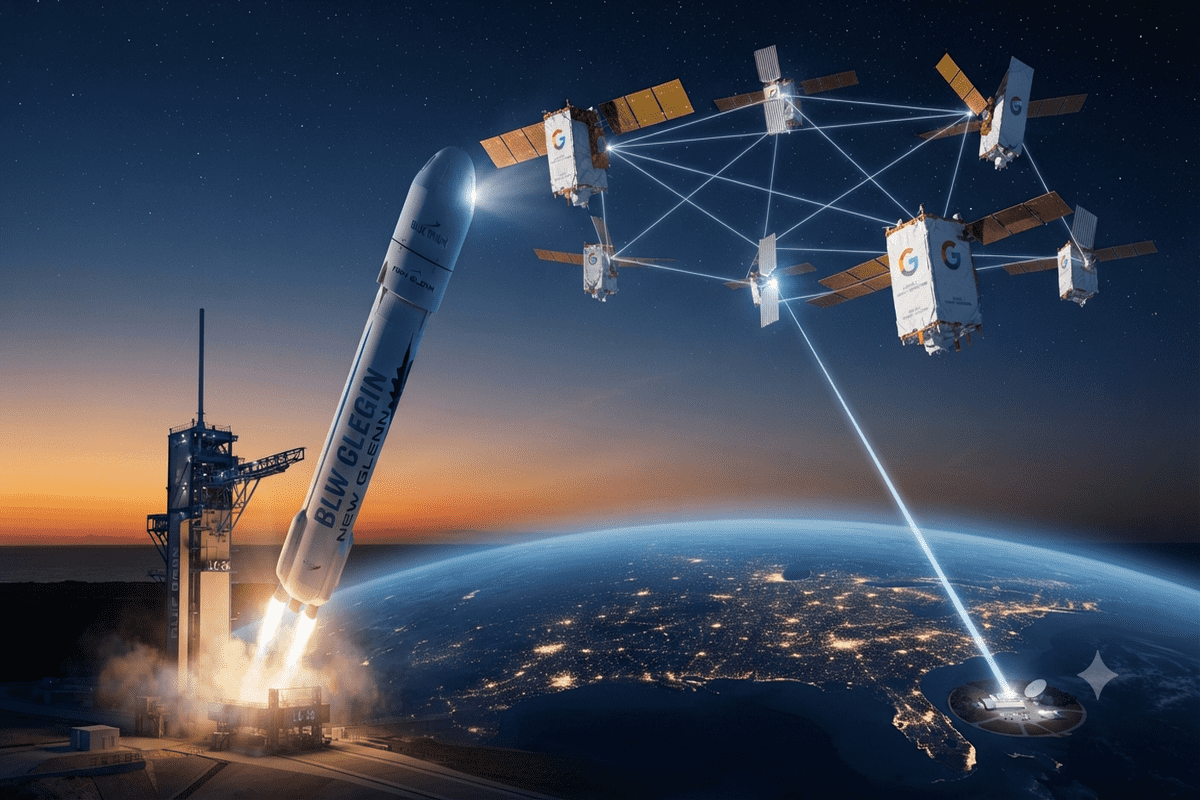
Earth’s power grids and freshwater supplies are buckling under the massive energy demands of modern artificial intelligence, making traditional server farms increasingly unsustainable. As terrestrial limits tighten, space-based AI infrastructure offers a breakthrough solution by shifting heavy compute loads off-planet. In a landmark partnership announced in November 2026, Blue Origin launching Google’s AI server satellites in Q1 2029 will mark the first dedicated heavy-lift mission for Project Suncatcher. In this deep dive, we explore how this mission works, why tech giants are racing to build orbital data centers, and what this leap means for the future of cloud computing.
Table of Contents
What Is Google’s AI Satellite Project?
For years, tech analysts have debated when data centers would leave Earth. That timeline officially locked in when Google signed a launch services agreement with Jeff Bezos’s aerospace company to deploy solar-powered compute satellites aboard the New Glenn heavy-lift rocket.
Known internally as Google’s AI satellite project or Project Suncatcher this research moonshot aims to test whether interconnected constellations of satellites can run large-scale machine learning workloads in low Earth orbit. Rather than relying on strained regional power plants on the ground, each satellite in the 2029 mission will carry custom Google Tensor Processing Units (TPUs) with computing power roughly equivalent to a full server rack in a traditional data center.
To prepare for this dedicated 2029 flight, Google already took a crucial first step. In October 2026, Google and Planet Labs launched an initial prototype satellite aboard a SpaceX rideshare mission, successfully testing how TPU hardware survives launch vibrations and runs AI models in orbit.
How AI Data Centers in Space Work
Understanding how AI data centers in space work requires rethinking everything we know about terrestrial server farms. On Earth, data centers sit inside massive concrete warehouses tethered to electrical substations and municipal water pipes. In orbit, orbital computing technology relies on three core pillars:
- Sun-Synchronous Orbits: Blue Origin’s New Glenn rocket will deploy Google’s satellites into a specialized sun-synchronous orbit. By riding the terminator line between day and night, the spacecraft stay bathed in near-continuous sunlight, eliminating the need for massive backup battery banks.
- Radiative Thermal Management: Without air or water to carry heat away, AI computing in space uses closed-loop fluid heat pipes and large outward-facing radiator panels. These panels reject waste heat directly into the freezing vacuum of space via infrared radiation.
- Optical Inter-Satellite Links: Instead of running fiber-optic cables between server racks, orbital nodes communicate using high-speed laser links. These optical beams pass data between neighboring satellites and transmit processed AI results back down to ground stations.
If you want to understand how hardware architectures are evolving to handle these extreme workloads, explore our guide on next-generation AI chip architectures to see why custom silicon matters.
Why Google Is Sending AI Servers into Orbit
The economics and environmental realities of artificial intelligence explain why Google is sending AI servers into orbit. Training and running frontier AI models requires gigawatts of continuous electricity—an appetite that is quickly outpacing local grid capacity across North America and Europe.
By utilizing satellite technology for AI, Google taps into an abundant, clean energy source. According to Google Research’s Project Suncatcher findings, satellites operating in low Earth orbit can access near-constant solar illumination, generating up to eight times more solar power than equivalent solar panels installed on Earth.
Key Pros of Space Data Centers
Moving Google AI servers in space unlocks major operational advantages that terrestrial facilities simply cannot match:
- Zero Atmospheric Loss: Solar arrays in orbit capture unfiltered sunlight 24/7 without cloud cover, nighttime downtime, or seasonal dips.
- No Freshwater Consumption: Terrestrial data centers evaporate millions of gallons of water daily for evaporative cooling; orbital radiators require zero water.
- Unlimited Physical Footprint: Low Earth orbit eliminates zoning battles, land acquisition bottlenecks, and community pushback over noise and power grid strain.
- Built-In Physical Security: AI infrastructure in orbit is naturally isolated from terrestrial natural disasters, physical tampering, and local grid blackouts.
The Role of Blue Origin Space Technology in the 2029 Mission
A data center in the sky is only as viable as the rocket that puts it there. Launching heavy, radiation-shielded server payloads requires massive lift capacity and competitive launch economics which is where Blue Origin space technology enters the picture.
Blue Origin’s New Glenn rocket is specifically engineered for heavy-lift missions, featuring a 7-meter payload fairing that provides roughly twice the volume of standard commercial launch vehicles. This oversized fairing allows Google to pack larger, more capable solar arrays and radiator wings onto each satellite without cramped folding mechanisms.
Furthermore, New Glenn’s reusable first stage is designed for rapid turnaround. As industry analysts reported via Reuters coverage of the 2029 Google-Blue Origin deal, scaling orbital compute to a full gigawatt would eventually require thousands of satellites—making reusable heavy-lift rockets indispensable for bringing launch costs down to commercial viability.
Engineering Hurdles Facing Google Space Computing
While the 2029 launch is a massive milestone, Google space computing still faces steep technical challenges before commercial deployment becomes routine:
- Cosmic Radiation and Bitflips: Outside Earth’s protective magnetosphere, high-energy solar protons and cosmic rays can strike silicon chips, flipping binary bits and corrupting AI calculations. Google has already tested its Trillium TPUs in particle accelerators to verify that error-correcting software can keep models accurate over five-year mission lifespans.
- Hardware Maintenance: Unlike terrestrial server farms where technicians can swap out a failing motherboard in minutes, space data centers cannot be easily repaired. Satellites must rely on autonomous fault tolerance and redundant compute nodes.
- Orbital Debris Management: Adding hundreds or thousands of compute satellites to low Earth orbit demands strict collision-avoidance automation and end-of-life deorbiting protocols to keep orbital lanes safe.
For businesses preparing their cloud budgets for these architectural shifts, check out our enterprise cloud infrastructure planning checklist to benchmark your current compute costs.
Actionable Insights for Tech Leaders and Investors
You do not need to book a rocket launch to prepare for the future of space-based AI computing. Here is how technology leaders and analysts should track this shift over the next three years:
- Monitor Optical Networking Standards: Watch for breakthroughs in free-space optical communications, as laser-link bandwidth will dictate how quickly space servers sync with terrestrial cloud regions.
- Evaluate Hybrid Edge-to-Orbit Workloads: Delayinsensitive tasks such as foundation model training, climate simulations, and Earth-observation data processing will be the first workloads migrated to orbit.
- Track Heavy-Lift Launch Cadence: Keep an eye on New Glenn flight milestones leading up to Q1 2029, as launch reliability and cost-per-kilogram remain the primary bottlenecks for orbital scale.
Conclusion
The partnership between Blue Origin and Google signals that off-planet computing has officially moved from sci-fi concept to funded aerospace engineering.
By combining reusable heavy-lift rockets, custom TPU silicon, and near-continuous orbital solar power, the Q1 2029 Project Suncatcher mission will test whether the cloud can truly leave Earth behind. As terrestrial energy constraints tighten, space-based AI infrastructure is rapidly emerging as the ultimate pressure valve for global compute growth.
Want to stay ahead of the biggest shifts in cloud hardware and orbital tech? Subscribe to our weekly tech briefing or explore our latest deep dives into sustainable AI infrastructure today.
Frequently Asked Questions
When will Blue Origin launch Google’s AI server satellites?
Blue Origin is scheduled to launch Google’s dedicated Project Suncatcher AI satellites in the first quarter of 2029 aboard its heavy-lift New Glenn rocket. This mission builds upon Google’s earlier October 2026 prototype test flight to validate full rack-scale computing in orbit.
Why does Google want to build AI data centers in space?
Google is exploring orbital data centers to bypass Earth’s growing power grid bottlenecks, land shortages, and freshwater cooling constraints. In a sun-synchronous orbit, solar panels capture near-continuous sunlight and generate up to eight times more energy than ground-based installations.
How do satellites cool down powerful AI chips without air or water?
Because space is a vacuum without convective airflow, orbital AI servers use closed-loop fluid heat pipes connected to large external radiator panels. These specialized panels absorb thermal energy from the TPU chips and radiate it directly into deep space as infrared heat.
What happens if space radiation hits Google’s AI processors?
Cosmic rays and solar particles can cause single-event upsets, or bitflips, that temporarily alter data inside silicon chips. Google mitigates this by running particle-beam radiation tests on Earth and deploying advanced error-correcting algorithms that detect and fix corrupted calculations automatically.
Get real time update about this category directly on your device, subscribe now.
Have any thoughts?
Share your reaction or leave a quick response — we’d love to hear what you think!
-
 0
- 0
- 0
- 0
- 0
- 0