Barsha Chowdhury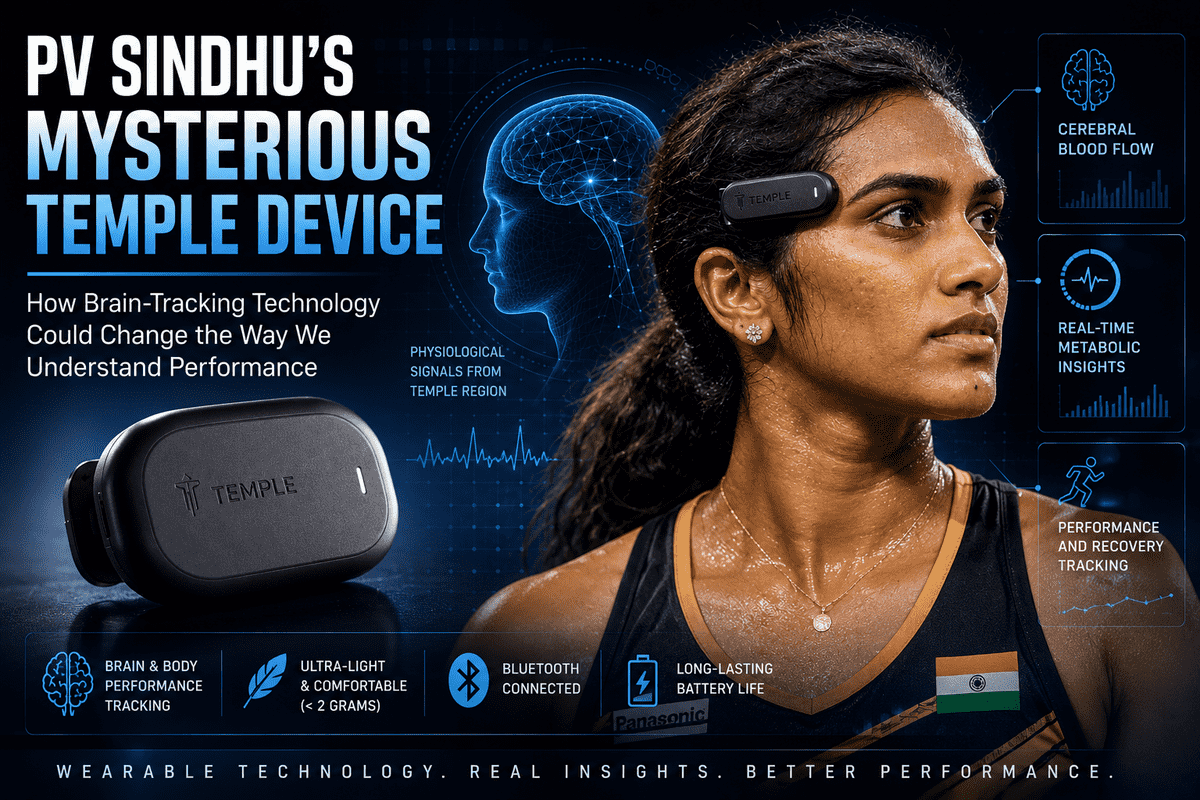
Table of Contents
Ever wondered what the small gadget on PV Sindhu’s forehead is while she competes? The PV Sindhu Temple device has attracted attention because it looks nothing like a conventional smartwatch or fitness band. But what does it actually measure and can it really tell us something useful about athletic performance?
The answer is more interesting than the mystery. Temple is an experimental brain tracking wearable designed around physiological signals and performance-related measurements. This article explains what the Temple wearable is, how it works, what its “Entropy” biomarker means, why athletes could find it useful, and where the technology still has limitations.
What Is the PV Sindhu’s Temple Device?
The device seen on Sindhu is called Temple, an experimental wearable associated with entrepreneur Deepinder Goyal. Sindhu has been seen testing the device during elite badminton competition, including the 2026 Uber Cup and BWF World Championships.
Unlike a traditional fitness tracker worn around the wrist, the Temple wearable attaches to the temple region of the head. Reports have described its focus as tracking physiological signals associated with cerebral blood flow and cognitive demand.
Temple’s own website currently positions the product around a proprietary biomarker called Entropy, describing it as a measure of metabolic and sympathetic demand on the body.
That distinction is important: Temple should not be described as a device that “reads thoughts” or diagnoses mental-health conditions
How Does Temple Wearable Technology Work?
Tracking physiological signals
The idea behind this brain technology is to collect physiological information from the temple area and turn it into useful performance insights.
Temple’s FAQ says the device uses a standard PPG sensor, a technology also commonly used in health and fitness wearables. The company says the device weighs under 2 grams and is designed to sit flat on a hair-free area of the temple.
This makes Temple different from medical imaging systems. It is a compact smart wearable intended for continuous everyday data collection rather than a hospital-based brain scan.
What is the Entropy biomarker?
One of the most interesting aspects of Temple is its Entropy measurement.
According to Temple, Entropy represents the metabolic and sympathetic demand placed on the body the physiological “cost” of being active and alive. The company’s public description suggests that healthy physiological patterns involve lower demand at rest followed by appropriate increases during activity and recovery afterward.
For athletes, the attraction is straightforward: instead of looking only at external performance, a wearable could potentially help researchers and coaches understand how the body responds internally to training and competition.
Why Could the Temple Device Matter for Athletes?
Elite sport increasingly relies on data. Athletes already use GPS trackers, heart-rate monitors, sleep trackers and other wearable technology to understand training load and recovery.
A cerebral blood flow wearable represents a different direction: bringing more attention to physiological signals associated with the brain and head.
For an athlete such as Sindhu, the potential applications could include:
- Comparing physiological responses during training and competition
- Understanding recovery patterns after demanding sessions
- Identifying changes in performance-related physiological signals
- Building a longer-term personal baseline
- Studying how intense physical effort affects the body
However, these should be understood as potential applications rather than proven performance benefits. Temple is still an emerging technology, and independent evidence about exactly how much it improves athletic outcomes remains limited.
sources:
PV Sindhu and the Future of Performance Tracking
Sindhu’s use of Temple is significant because elite athletes can become early testing grounds for emerging technology.
During the Uber Cup, Sindhu was reported to have been testing the device, with her team reviewing the resulting metrics. More recently, the device attracted attention when she was seen wearing it during the BWF World Championships in New Delhi.
This illustrates a larger change in sports technology. The goal is gradually moving beyond simply asking:
“How hard did the athlete train?”
The next question could be:
“How did the athlete’s body respond to that training?”
That distinction could make brain and body performance tracking increasingly valuable in elite sport.
What Temple Does—and Does Not—Claim to Do
It is easy for exciting neurotechnology to become exaggerated online. Temple’s own documentation provides important boundaries.
What it is designed for
Temple describes its product as a general-wellness technology and provides physiological and derived metrics through its device and app. Its privacy policy lists metrics including heart rate, HRV, respiratory rate, activity, sleep and recovery information.
What it is not
Temple explicitly states that its device is not a medical device and should not be used to diagnose, treat, cure or prevent medical conditions. The company also says its measurements should not be assumed to have the accuracy of professional medical or scientific measurement devices.
So, descriptions such as “mind-reading gadget,” “mental-health diagnostic device” or “medical brain scanner” go beyond what the company officially claims.
Could Brain-Tracking Wearables Become the Next Fitness Trend?
The potential of wearable technology lies in continuous measurement.
A smartwatch can tell you about your heart rate. A sleep tracker can show sleep patterns. A performance wearable can estimate training load. Experimental brain-focused wearables could add another layer by examining physiological signals associated with the head and brain.
But the real value will depend on validation.
For experimental brain wearables, important questions remain:
- How accurately are the signals measured?
- How consistent are readings between individuals?
- Can the data reliably predict recovery or performance?
- How should coaches interpret the measurements?
- What happens to highly personal physiological data?
Temple’s own privacy policy says it processes personal and wellness data and describes safeguards such as encryption and access controls.
As this field develops, scientific validation and responsible data handling will be just as important as making the device smaller and smarter.
The Bigger Picture: From Fitness Tracking to Human Performance
The excitement surrounding the PV Sindhu Temple device is not simply about one unusual gadget.
It reflects a broader movement toward personalised performance technology. Instead of relying entirely on generic recommendations, future smart wearables could build individual physiological baselines and show how a particular person’s body responds to exercise, sleep, competition and recovery.
Temple itself describes its mission around understanding physiological demand and long-term wellness rather than simply producing another fitness score.
For athletes, that could eventually mean more informed training decisions. For everyday users, it could mean a deeper understanding of how lifestyle choices affect their physiological state.
But the technology is still developing. Its promise should therefore be viewed alongside its limitations rather than as a finished revolution.
Is Temple the Future of Performance Tracking?
The PV Sindhu Temple device offers a fascinating glimpse into where wearable technology could be heading. Positioned on the temple rather than the wrist, it focuses on physiological signals and introduces Temple’s proprietary Entropy concept for understanding metabolic and sympathetic demand.
For elite athletes, the potential is significant: better longitudinal data could eventually complement traditional measurements of training, recovery and performance. Yet Temple remains an emerging technology, and its claims should be interpreted carefully.
The most exciting part may not be that one device can “understand the brain,” but that brain technology and wearable technology are beginning to overlap in new ways.
Frequently Asked Questions
1.What is the PV Sindhu Temple device?
Temple is a small experimental wearable worn near the temple. It is designed to collect physiological signals and generate performance and wellness-related insights, rather than read thoughts or diagnose medical conditions.
2.What does the Temple wearable measure?
Temple’s official website highlights its Entropy biomarker, which it describes as reflecting metabolic and sympathetic demand. Its broader ecosystem also collects physiological and wellness metrics.
3.Does Temple read your thoughts?
No. There is no basis for describing Temple as a mind-reading device. It is designed to track physiological signals and provide wellness and performance-related information.
4.Is Temple a medical device?
No. Temple explicitly says its device is not a medical device and should not be used for diagnosis or treatment. Medical decisions should always rely on qualified healthcare professionals.
5.Why might athletes use a brain tracking wearable?
Athletes may use emerging wearables to collect additional physiological data during training and recovery. However, the specific performance benefits of Temple still require further independent validation.
Get real time update about this category directly on your device, subscribe now.