Sakshi Dhingra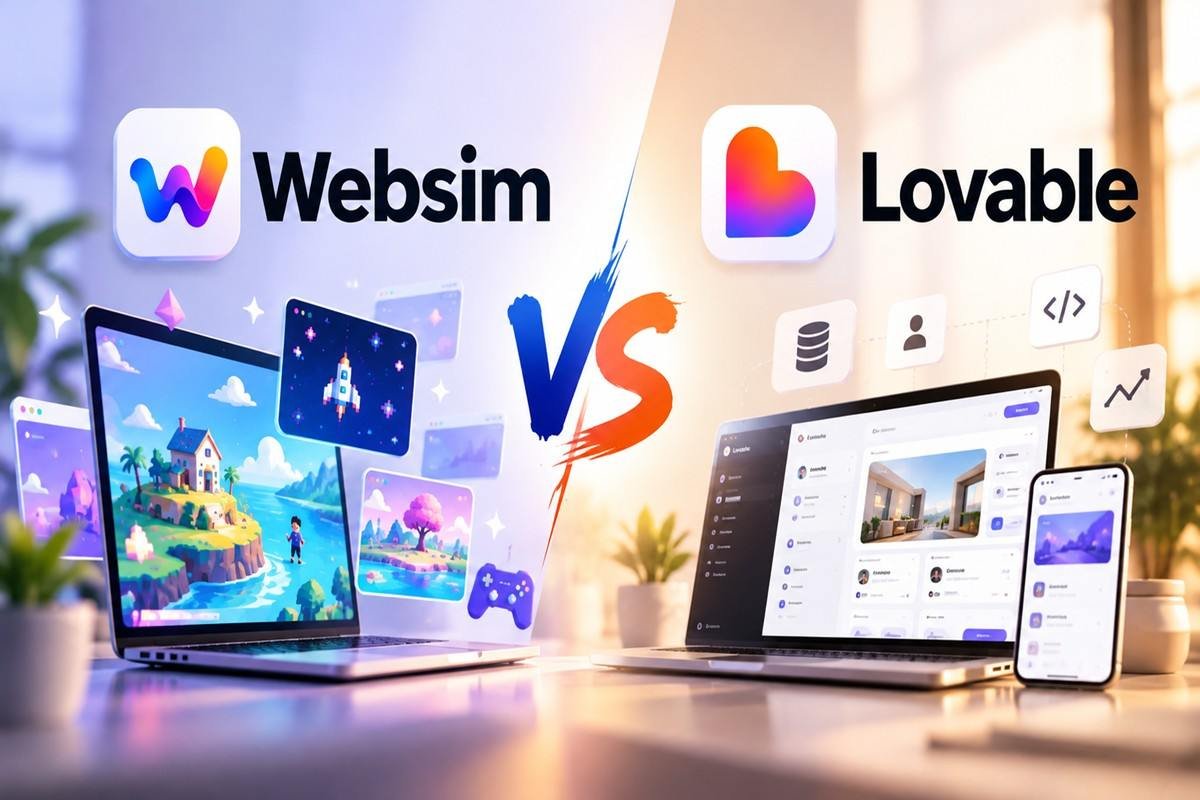
By early 2026, Lovable was reporting roughly 400 million dollars in annual recurring revenue and more than 25 million projects built on its platform, according to figures shared with TechFundingNews. Websim took a different road entirely, growing a devoted community around a browser playground where a single prompt can conjure a working game, a fake operating system, or an interactive art piece in seconds.
Both tools convert plain language into running web code, but they answer very different questions. Websim AI is built for fast creative experimentation and shareable interactive experiences. Lovable is built for structured, production-oriented web applications with real databases, authentication, and deployable code.
The short version of this Websim AI vs Lovable comparison: choose Websim when the goal is imaginative, interactive, and social, and choose Lovable when the goal is a functioning product you intend to ship and maintain.
| Quick answer. Websim AI and Lovable are both AI web builders, but they serve different goals. Websim generates interactive websites, browser games, and creative experiments hosted inside its own community, while Lovable builds full-stack applications with a Supabase backend, authentication, editable code, and custom-domain deployment. Choose by outcome: creative play versus production software. |
Table of Contents
Research and Review Methodology
This assessment draws on official documentation, public product demonstrations, published user projects, and verified third-party reviews rather than a controlled hands-on test lab. No claim of personal, controlled testing is made, and the project scenarios are labeled as scenario-based estimates built from documented capabilities and community evidence.
Sources examined include Websim’s own blog and documentation, Lovable’s documentation and public pricing information, review platforms such as G2 and Trustpilot, funding and revenue reporting from Sacra and TechFundingNews, and independent security testing summarized by TheNextWeb and specialist testers. Pricing was checked in late July 2026 and other figures in early August 2026. Because both platforms change rapidly, every price, rating, and feature should be re-verified against the live source before relying on it.
Scores were derived from documented features, the scenario analysis, and recurring themes in verified user feedback, then combined using the transparent weighting described in the scoring section. Where reliable public data was unavailable, most notably a representative star rating for Websim, that gap is stated plainly rather than filled with an estimate.
Limitations in the evidence include the polarized and partly moderated nature of some review profiles, the absence of Websim from major review sites, and the difficulty of measuring security or production readiness without direct, project-specific testing.
Websim AI vs Lovable: the core difference
Websim AI, defined simply: a browser-based, prompt-to-web playground that generates interactive sites, games, simulations, and AI-powered mini-apps you can share and remix inside a community feed.
Lovable, defined simply: an AI app builder that turns natural-language prompts into full-stack web applications, complete with a React front end, a Supabase database, authentication, and code you can export to GitHub.
Put another way, Websim optimizes for the moment of creation and sharing, while Lovable optimizes for the moment of shipping and scaling. That single distinction shapes almost every practical difference below, from pricing to backend support to whether the output is something you would put in front of paying customers. The table that follows summarizes the contrast before the detailed analysis begins.
Quick comparison at a glance
| Attribute | Websim AI | Lovable |
| Primary use case | Interactive web experiences, games, creative experiments | Structured full-stack web applications |
| Target user | Beginners, hobbyists, creators, students | Founders, product teams, developers, agencies |
| Ease of use | Very high, post-and-remix flow | High, with a credit and backend learning curve |
| Prompt-to-output speed | Seconds to a shareable result | Minutes to a working app |
| Website creation | Strong for creative and landing pages | Strong for app-style and marketing sites |
| Web app development | Limited, front-end and hosted AI only | Core strength, real app logic |
| Game and interactive creation | Excellent, a headline feature | Possible but not the focus |
| Backend support | None in a production sense | Yes, via Supabase and Lovable Cloud |
| Database support | Not a real database | PostgreSQL through Supabase |
| Authentication support | Not for production accounts | Yes, email, OAuth, magic links |
| Code access | Static HTML export only | Editable code, Code mode on paid plans |
| GitHub integration | No native sync | Yes, two-way GitHub sync |
| Custom domain support | Not native, export and self-host | Yes, on paid plans |
| Hosting and deployment | Hosted in the Websim feed | One-click publish, custom domains, Cloud |
| Design flexibility | Highly experimental and varied | Consistent modern, responsive UIs |
| Mobile responsiveness | Depends on the generated project | Generally responsive by default |
| Collaboration features | Remix and community, real-time play | Workspaces, roles on paid plans |
| Third-party integrations | Mostly internal AI abilities | Supabase, GitHub, Stripe, Slack, more |
| Free plan | Yes, free models, no free daily credits | Yes, five daily credits, capped monthly |
| Entry-level paid price | Approx. 10 dollars per month (unverified) | 25 dollars per month (Pro) |
| Commercial-use suitability | Prototypes and entertainment | Commercial apps, with security review |
| Learning curve | Minimal | Moderate |
| Community support | Reddit and Discord driven | Large community plus deep docs |
| Best suited for | Creative, playful, shareable web | Real products you plan to ship |
| Main limitation | No production backend or ownership | Credit burn and default security gaps |
| Overall rating | 5.8 / 10 (weighted) | 8.3 / 10 (weighted) |
Every entry reflects official documentation and verified third-party sources checked in late July and early August 2026. Pricing and features change often.
Websim AI at a Glance

Websim describes itself, on its own blog, as an online platform for anyone who wants to turn a casual idea into a shared experience. The workflow is deliberately simple. A user types an idea, the AI writes all of the code, and within seconds a testable, playable result appears in the browser.
When it is ready, a single Post button publishes it to a public feed where other people can like, comment, remix, or gift credits as a thank-you. That loop, create then share then remix, is the heart of the product and the reason its audience feels more like a creative community than a software tool.
The typical outputs skew toward the imaginative: browser games, interactive art, fictional interfaces, simulations, retro operating-system recreations, and small AI-powered utilities. Websim added the ability to build AI apps such as chatbots, image generators, and voice tools without touching API keys or servers, and the platform wires those abilities up automatically.
Everything runs for free inside Websim and stays instantly shareable and remixable. According to the company, the homepage algorithm is tuned to surface projects that match a user’s taste rather than only the most popular work, which reinforces the discovery-driven culture.
Lovable at a Glance

Lovable is a full-stack AI app builder from a Stockholm company founded in November 2023 by Anton Osika and Fabian Hedin. It began life as the open-source project GPT Engineer before rebranding to signal a shift toward a broader, less technical audience. The bet paid off.
Lovable raised a 330 million dollar Series B at a 6.6 billion dollar valuation in December 2025, and reporting from Sacra and TechFundingNews places its annual recurring revenue at roughly 400 million dollars in early 2026, with more than half of the Fortune 500 using it in some form.
Those numbers matter less for their scale than for what they signal: this is a heavily resourced, fast-moving platform with real enterprise adoption.
The development workflow is conversational. A user describes an application in plain English and Lovable generates a working full-stack app built on React, TypeScript, and Tailwind CSS, with a Supabase backend handling the database, authentication, and server logic.
Based on Lovable’s own documentation, connecting Supabase lets the AI create user accounts, store and query data in PostgreSQL, upload files, apply row-level security, and run serverless edge functions, all from natural-language prompts. Payments arrive through Stripe, and the platform also offers a managed option called Lovable Cloud for teams that would rather not wire up Supabase themselves.
Feature-by-Feature Comparison
The sections below compare the two platforms across the dimensions that most influence a real buying decision. The pattern that emerges is consistent: Websim leads wherever creativity, speed, and playfulness matter, and Lovable leads wherever structure, data, and durability matter.
Prompt quality and interpretation
Both tools understand short prompts well, but they interpret intent differently.
Lovable tends to be literal and functional, translating a request like add a login page and save signups to the database into concrete UI plus a Supabase table. It handles follow-up instructions and design tweaks reliably, though users report it can loop on the same error during more complex logic.
Websim leans creative and will happily improvise beyond the brief, which is a feature for art and games and occasionally a nuisance when precision is the goal. For functional requirements, Lovable is the more predictable interpreter; for open-ended ideas, Websim’s willingness to run with a concept is part of the appeal.
Interface and usability
Websim has the gentler on-ramp. Creating a project means typing an idea and watching it appear, and posting to the feed is one click. There is almost nothing to configure.
Lovable is also approachable for non-coders, but it introduces concepts a beginner must absorb: credits, the difference between building and hosting, and when to connect a backend. Its previews and editing are clean, and error messages have improved, yet the overall surface area is larger.
For a first-time builder who just wants to make something, Websim feels lighter; for someone building toward a product, Lovable’s extra structure is worth the small added friction.
Design quality
Lovable produces consistently modern, responsive interfaces with sensible typography and layout, which is a large part of why designers and product managers praise it on G2. The output usually looks like a real application on both desktop and mobile without much prompting.
Websim’s design is more varied by nature. Because it is built for experimentation, results range from striking to rough, and visual polish depends heavily on the prompt and the project type.
For a clean, production-looking UI out of the box, Lovable is stronger; for distinctive, expressive, or retro aesthetics, Websim’s range is an advantage.
Application functionality
This is the widest gap in the comparison. Lovable handles forms, user accounts, dashboards, persistent data, API connections, payments, and multi-step workflows, because it is wired to a real backend.
Websim can create interactive front ends and hosted AI features, but it has no production database, no durable user accounts, and no server-side logic that survives outside the platform.
A quotable way to frame it: Websim builds things that feel interactive, while Lovable builds things that actually persist. Anyone whose project depends on storing and retrieving user data will find Lovable in a different category.
Creative generation
Here Websim reclaims the lead decisively. Browser games, animations, simulations, fictional interfaces, and artistic websites are its core territory, and the remix culture means a promising idea can be forked and extended by others. Multiplayer experiences and social experiments are first-class.
Lovable can build a simple interactive page, but it is not designed for game loops, physics, or runtime performance, and it offers nothing like Websim’s community canvas. For entertainment, art, and experimental web work, Websim is the more natural home.
Code access and ownership
Lovable gives users editable code, Code mode on paid plans, and clean GitHub repositories they own outright, with the Supabase project under their control and no vendor lock-in.
Websim offers a static HTML export that is genuinely useful as a starting point but comes with the caveat that hosted AI features do not survive the move, and there is no source-control workflow.
For developers who need to inspect, modify, extend, or hand off code, Lovable is far ahead. For a creator who simply wants to publish inside Websim, the abstraction is a convenience rather than a constraint.
Integrations
Lovable connects to Supabase, GitHub, Stripe, and a growing list of services including Slack and Twilio, plus built-in AI image generation.
Websim’s integrations are mostly internal: AI models and abilities that the platform wires up automatically, without external accounts or API keys. That trade is deliberate. Websim removes integration complexity to keep beginners moving, while Lovable exposes integrations because real applications depend on them.
For anyone assembling a product from real services, Lovable’s ecosystem is the more capable one.
Collaboration
The two platforms collaborate in different senses of the word. Websim collaboration is communal and creative: remixing, commenting, gifting credits, and playing multiplayer projects together.
Lovable collaboration is organizational: shared workspaces, unlimited collaborators even on the free plan, and roles and permissions on paid tiers, with version history through GitHub.
A studio building a game jam culture will prefer Websim’s model; a team building a product with access control will prefer Lovable’s.
Deployment
Lovable offers one-click publishing to a lovable.app subdomain, custom domains on paid plans, and managed hosting through Lovable Cloud, with the ability to export and host elsewhere.
Websim publishes to its own feed and supports a static download, but moving a live project off the platform means rebuilding its dynamic pieces, and there is no native custom-domain path.
For a public, maintainable deployment, Lovable is built for it; for sharing a creation with a community, Websim’s feed is the point.
Reliability
Neither platform is flawless, and the failure modes differ. Websim output can vary in quality, and independent trackers noted a meaningful traffic decline through 2026 that some attributed to paywalls and a rise in low-quality community content, which is a third-party observation rather than a company statement.
Lovable is fast but can get stuck in repetitive error loops on complex builds, and reviewers frequently mention that the first draft reaches perhaps seventy percent of a usable product while the last thirty percent takes real effort. Both reward patience and iteration; neither should be treated as a one-shot machine.
Privacy and security
Security is the most consequential area of the comparison for anyone handling real user data. Independent testing published in 2026, along with reporting by TheNextWeb, documented recurring security gaps in Lovable-generated applications, most commonly broken access control when default code was deployed without manually configuring row-level security, and in a few cases exposed Supabase service-role keys.
Broader studies cited in that coverage found that a large share of AI-generated code contains vulnerabilities. Lovable has responded by adding an automated pentesting feature and partnering with security firms, but the practical takeaway stands: Lovable output is not secure by default and must be reviewed before launch.
Websim raises a different concern. Projects are frequently public and community-facing by design, so it is not the place for sensitive or proprietary work, and its terms and hosted nature make it unsuitable for confidential commercial projects. In both cases, caution is warranted, and neither should be assumed secure without verification.
Commercial use
Lovable is used commercially at scale, including by large enterprises, and it is a reasonable foundation for client work, internal tools, and paid products provided the security review above is taken seriously.
Websim is better understood as a place for prototypes, concepts, and entertainment than for client production, given the absence of a real backend, ownership limits, and the public, community-oriented hosting model. A fair summary: Lovable can be part of a commercial stack, while Websim is usually a creative sandbox that sits before the commercial stack.
Performance Across Realistic Projects
The assessment below is scenario-based rather than a controlled hands-on test. It draws on documented capabilities, public product demonstrations, and verified user feedback, and it estimates which platform is likely to perform better for each project type. The scores in the chart use the same ten-point scale as the rest of this review.

Scenario suitability estimates based on documented capabilities and public demonstrations, not a controlled hands-on test.
Simple business landing page. Both tools do this well. Websim is faster to a shareable draft and Lovable produces a more polished, conversion-ready page with working forms, so the pick depends on whether speed or form handling matters more.
Interactive portfolio. Websim has the edge for anything expressive or animated, where its creative range shines. Lovable is the better choice only if the portfolio needs a contact form that stores messages.
Browser-based game. Websim wins clearly. Game loops, playful mechanics, and instant sharing are exactly what it is built for, and Lovable is not designed for this.
SaaS dashboard. Lovable wins clearly. Persistent data, charts, user accounts, and role-based views require the real backend that Websim does not provide.
Membership application with accounts. Lovable is the only realistic option. Authentication, protected pages, and stored profiles are core Supabase features, and Websim cannot deliver production accounts.
Lead-generation website. Lovable is stronger because it can capture and store leads and connect analytics, though Websim can produce an attractive top-of-funnel page if the data is handled elsewhere.
E-commerce prototype. Lovable leads thanks to Stripe and database support for products and orders. Websim can mock up a storefront visually but cannot process real transactions.
Data-driven internal tool. Lovable is the practical winner. Internal tools live or die on data, permissions, and reliability, all areas where Websim is not equipped to compete.
Pricing and Overall Value
All pricing here was checked against public sources in late July 2026, and both platforms change plans frequently, so the live pages should be verified before purchase. Lovable publishes its tiers openly. Websim does not display full plan pricing without signing in, so its paid figures below rely on third-party estimates and are labeled as unverified rather than presented as fact.
| Plan aspect | Websim AI | Lovable |
| Free plan | Yes, free AI models; free daily credits were discontinued in January 2026 | Yes, five daily credits capped at 30 per month |
| Lowest paid plan | Starter or Pro, or one-time credit purchases | Pro |
| Monthly cost | Approx. 10 dollars per month (third-party estimate, unverified) | 25 dollars per month for Pro; 50 for Business |
| Annual billing option | Not clearly published | Yes, roughly 20 percent saving reported |
| Usage credits or limits | Credit-based; buy credits or earn via engagement | Credit-based; 100 monthly credits on Pro |
| Project limits | Community projects, generous for creation | Five subdomains on free; more on paid |
| Private project availability | Projects are typically public and remixable | Private projects on Pro and above |
| Custom domain availability | Not native; export and self-host | Yes, on paid plans |
| Code export | Static HTML download | Editable code and GitHub sync (Code mode) |
| Collaboration features | Remix and community; multiplayer | Unlimited collaborators; roles on paid |
| Commercial-use terms | Best for prototypes and entertainment | Permitted; review security before launch |
| Important restrictions | Hosted AI features do not run off-platform | Cloud hosting and AI usage billed separately |
Pricing checked late July 2026. Lovable figures are from its public pricing page; Websim paid figures are third-party estimates. Verify live pages before buying.

On value, the two tools win for different users. Websim is hard to beat for experimentation and occasional creative use: free models cover a lot, and the community rewards good work with tips, though the discontinuation of free daily credits in January 2026 narrowed the free tier.
Lovable offers strong value for professional development because a single Pro subscription is shared across an entire workspace rather than charged per seat, but reviewers consistently warn that credits deplete faster than expected and that Cloud hosting plus AI usage are billed on top of the plan.
For a hobbyist, Websim is cheaper to enjoy. For a founder or agency shipping real products, Lovable is more cost-effective than hiring developers, provided credit usage is monitored. No plan on either platform should be described as unlimited, because neither one is.
Ratings and User Feedback
Ratings were collected from platforms where genuine listings exist, with dates noted because sentiment shifts.
Two cautions apply.
First, Websim has no substantial presence on the major software review sites, so there is no representative star rating to report for it, and its feedback lives on Reddit, Discord, and video demonstrations instead.
Second, a near-identical misspelled domain exists for Lovable, and its handful of reviews were excluded to avoid mixing unrelated data.
| Review source | Websim AI | Lovable | Date checked |
| G2 | No substantial listing | 4.6 / 5 from 273 reviews | Aug 6, 2026 |
| Trustpilot | No substantial listing | Near 4.0 / 5 from 1,400+ reviews | Aug 6, 2026 |
| Product Hunt | Community upvotes only | Community upvotes only | Aug 6, 2026 |
| Reddit and Discord | Active community, no numeric score | Active community, no numeric score | Aug 6, 2026 |
Product Hunt upvotes are not customer-review ratings, and Reddit sentiment is not converted into a numeric score. Websim lacks a representative sample on formal review sites.

Lovable’s Trustpilot profile is polarized. A large majority of reviewers rate it five stars and praise the speed and ease of turning an idea into a working app, yet a notable minority leave one-star reviews, with recurring complaints about credit costs, unresolved errors, and, in a few unprompted cases, billing disputes.
Trustpilot itself notes that it removed fake reviews from the profile, so the distribution should be read as indicative rather than precise. On G2, the picture is warmer, with a 4.6 average across 273 verified reviews as of the check date, where designers and founders highlight prototyping speed and the Supabase and GitHub integrations, while the most common criticism is that the credit model takes getting used to as usage grows.
Recurring praise for Websim: creativity, speed, entertainment value, the remix culture, and the sheer surprise of what it can produce. Beginners in particular value that it removes technical barriers entirely.
Recurring criticism of Websim: limited control over output, no real code ownership, uneven project reliability, and unsuitability for production. These are widespread themes in community discussion rather than isolated gripes.
Recurring praise for Lovable: speed, interface quality, the Supabase integration, GitHub access, and how quickly a non-technical user can reach a working app. These points recur across G2 and Trustpilot alike.
Recurring criticism of Lovable: credit burn, occasional prompt regressions and debugging loops, pricing surprises from separate hosting and AI charges, and questions about production readiness. Billing complaints appear but are less common than credit and debugging feedback.
Scoring Methodology
Each platform is rated out of ten across fifteen categories. The overall score uses a transparent weighted system that emphasizes application functionality and backend depth, because those dimensions most separate a creative tool from a production tool.
The weighting is: application functionality fifteen percent; ease of use, prompt accuracy, design quality, backend capabilities, and code control ten percent each; reliability and deployment eight percent each; integrations and value for money seven percent each; and support and documentation five percent.
Four further categories, creative flexibility and beginner, developer, and commercial suitability, are scored for context but sit outside the weighted total. Scores reflect documented features, scenario analysis, and verified user feedback rather than artificial precision.

The weighted result is 8.3 out of 10 for Lovable and 5.8 out of 10 for Websim. That gap is real, but it is a product of the weighting, which rewards the production capabilities Websim was never built to provide. On a rubric weighted toward creativity and shareability, the two would sit much closer, and Websim would likely lead. The scores measure fitness for shipping software, not overall worth.
| Category | Websim | Lovable | One-line rationale |
| Ease of use | 9 | 8 | Websim’s post-and-remix flow is near frictionless; Lovable adds credit and backend concepts. |
| Prompt accuracy | 7 | 8 | Lovable is more literal for functional apps; Websim improvises creatively. |
| Design quality | 7 | 9 | Lovable ships consistent modern UIs; Websim’s look is more varied. |
| Application functionality | 5 | 9 | Lovable handles forms, dashboards, and accounts; Websim is front-end and hosted AI only. |
| Backend capabilities | 3 | 9 | Lovable pairs with Supabase for data, auth, and logic; Websim has no production backend. |
| Code control | 5 | 9 | Lovable offers editable code and GitHub sync; Websim exports static HTML only. |
| Deployment | 5 | 8 | Lovable supports one-click publish and custom domains; Websim shares via its feed. |
| Integrations | 4 | 9 | Lovable connects Supabase, GitHub, and Stripe; Websim’s abilities are internal. |
| Reliability | 6 | 6 | Both show rough edges; Websim output varies, Lovable can loop and needs hardening. |
| Value for money | 8 | 7 | Websim is generous for creative play; Lovable’s credits burn faster than the sticker. |
| Support and documentation | 5 | 8 | Lovable has deep docs and a big community; Websim leans on Discord and Reddit. |
| Creative flexibility | 9 | 6 | Websim is built for games, art, and experiments; Lovable is more buttoned-down. |
| Beginner suitability | 9 | 8 | Both welcome non-coders; Websim removes even the idea of a backend. |
| Developer suitability | 4 | 8 | Lovable gives developers real code and repos; Websim abstracts the code away. |
| Commercial suitability | 4 | 7 | Lovable is used commercially but needs review; Websim suits prototypes, not client production. |
| Overall (weighted) | 5.8 | 8.3 | Lovable leads on a production-weighted rubric; a creativity-weighted one would narrow the gap. |
Scores derive from documented features, scenario analysis, and verified user feedback. The weighted overall favors production capability by design.

Category scores across the eleven weighted criteria. Websim leads on ease of use and value; Lovable leads on nearly everything tied to shipping software.
Strengths and Limitations
Websim’s greatest strength is that it makes creation feel effortless and social. For a student, a hobbyist, or an artist who wants to build a browser game or an interactive experiment and share it in minutes, its speed and remix culture are genuinely hard to match. That same creative flexibility, though, becomes a limitation the moment a project needs structure.
A user who wants to store customer records, protect a members area, or hand a codebase to a developer will hit a wall, because Websim offers no production database, no durable authentication, and no real code ownership. Its output is meant to live and be remixed inside Websim, and pulling it out strips away the hosted AI that made it interesting.
Lovable’s greatest strength is that it compresses the distance from idea to shipped product. It generates polished, responsive interfaces backed by a real Supabase database, authentication, and editable code that syncs to GitHub, which is why founders and agencies can validate and launch quickly. Its production-oriented workflow, however, introduces complexity that casual creators may not want.
The credit model requires attention, complex builds can trigger debugging loops, and, most importantly, the generated code is not secure by default and needs manual hardening such as configuring row-level security before real users arrive. For a weekend experiment, that overhead is more than the task requires; for a product, it is the price of building something durable.
Best Choice for Different Users
Complete beginners: Websim, for the gentlest possible start. It removes almost every technical concept and rewards curiosity, which builds confidence faster than a full app builder would.
Non-technical founders: Lovable, because validating a real product idea means having data, accounts, and a deployable app, not just an interactive mockup.
Professional developers: Lovable, for the editable TypeScript, GitHub sync, and Supabase control that let them extend or take over the codebase in familiar tools.
Designers: both, in sequence. Websim is a fast sketchpad for expressive concepts, while Lovable turns an approved design into a responsive, working front end.
Marketers: Lovable for lead capture, landing pages that store submissions, and analytics; Websim only when the goal is a purely creative campaign piece.
Students: Websim for learning by doing and for playful projects, with Lovable’s student discount worth using once coursework moves toward real applications.
Game creators: Websim, without hesitation. Browser games, mechanics, and instant multiplayer sharing are its home ground.
Content creators: Websim for interactive, shareable pieces that engage an audience, since novelty and remixing are the whole point.
Agencies: Lovable for client deliverables, with a firm commitment to reviewing security and monitoring credit usage before anything ships to a client’s users.
SaaS founders: Lovable, clearly. A subscription product needs authentication, persistent data, payments, and deployment, all of which Websim lacks.
Small businesses: Lovable for a real website or internal tool that stores information; Websim only for a lightweight, one-off creative page.
Rapid prototyping teams: both, matched to the prototype. Websim for a throwaway interactive concept, Lovable for a functional prototype meant to evolve into a product.
Users building internal tools: Lovable, because internal tools depend on data, permissions, and reliability that only its backend provides.
Users creating experimental web experiences: Websim, the entire reason the platform exists. Nothing in this comparison serves that goal better.
Alternatives Worth Considering
Several other tools overlap with parts of what Websim and Lovable do, and each was confirmed active in 2026. They are worth a look when a specific need falls outside the sweet spot of either platform.
Bolt.new: a browser-based full-stack builder known for fast iteration; a strong Lovable alternative when quick in-tab experimentation matters more than a managed backend.
Base44: an all-in-one app builder now owned by Wix, with a built-in database, authentication, and hosting; appealing when a non-technical user wants batteries included and no external services.
Replit: an online IDE with an AI agent; better than either tool for developers who want an AI assistant inside a full coding environment.
v0 by Vercel: focused on generating React and Next.js UI with clean exportable code; a good pick when the front end is the priority and developers handle the rest.
Rosebud AI: a game-first platform with a 3D game maker and AI characters; the closest specialist alternative to Websim for people who mainly want to build games.
Framer AI: design-led website generation with polished output; strong when a marketing site’s visual craft matters most.
Claude Artifacts and Google AI Studio: quick ways to prototype interactive pieces or test ideas against a model; useful for lightweight experiments closer to Websim’s spirit than Lovable’s.
Cursor: an AI code editor for developers; the right tool when someone wants AI assistance while writing and owning the code directly.
Bubble: a mature visual no-code platform for long-lived applications; worth considering over Lovable when a team wants an established ecosystem rather than an AI-first generator.
Final Verdict
There is no universal winner in the Websim AI vs Lovable question, because the two tools are built for different jobs and both do their job well. Websim wins for creative experimentation, interactive web experiences, browser games, and fast visual concepts, where its speed and community are unmatched. Lovable wins for structured web applications, backend-connected products, commercial deployment, code ownership, and long-term development, where its Supabase-powered stack and editable code do work Websim cannot.
| Choose Websim AI when the main goal is to turn imaginative prompts into interactive web experiences quickly, and when sharing and remixing inside a creative community is part of the appeal. Choose Lovable when the main goal is to build a structured application with greater control over code, backend services, deployment, and future development, and when the output must eventually stand up to real users. |
For most readers the decision comes down to one honest question: is the end goal a creation to share, or a product to run? If the former, Websim is the more joyful and capable choice. If the latter, Lovable is the more serious tool, as long as its credit costs are watched and its default security gaps are closed before launch.
Get real time update about this category directly on your device, subscribe now.