Nitin Tayal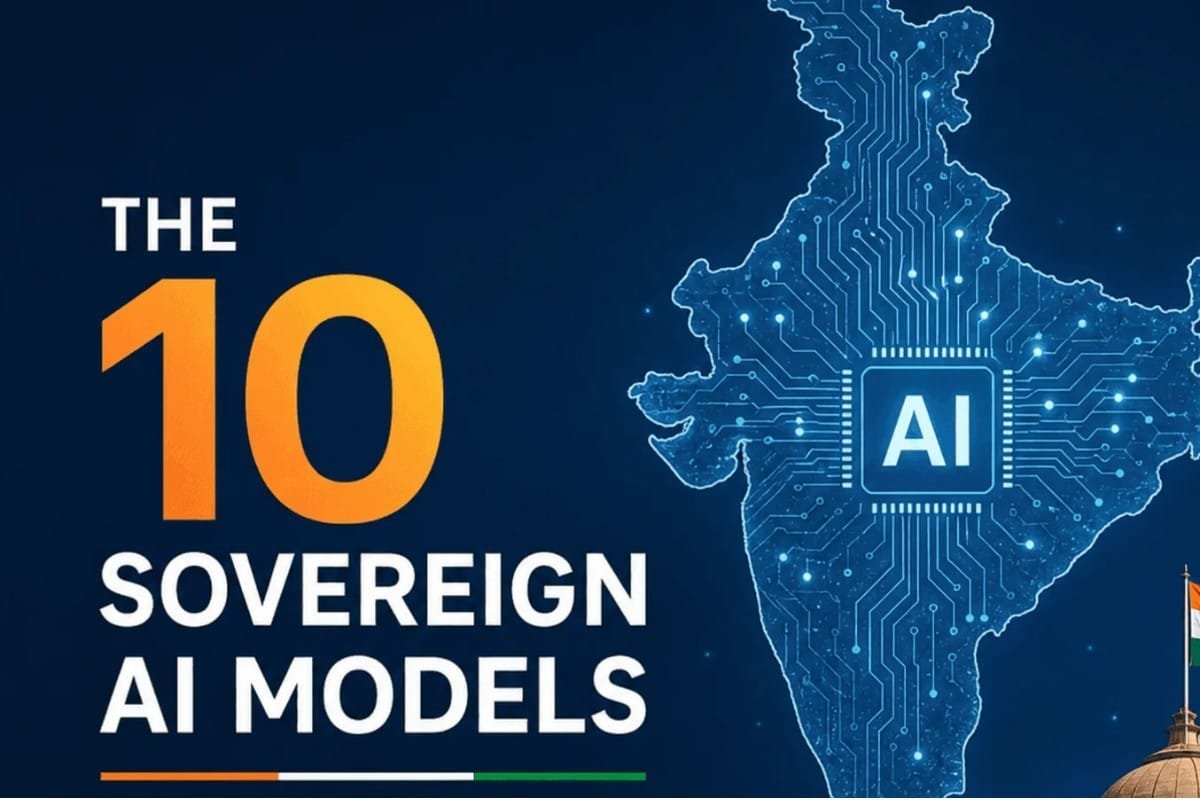
The idea of sovereign AI has always sat in an awkward place. On paper it sounds like chest thumping. In practice it is about something way more boring and way more important: control.
And the timing is not subtle. When access rules around frontier models change overnight, it is a reminder that AI infrastructure is not some neutral public utility. It lives inside jurisdictions. It answers to national security frameworks. It can be switched off.
That is basically the backdrop to why India is putting real money behind domestic foundation models under the IndiaAI Mission, cleared by the Union Cabinet in March 2024, with a total outlay of Rs 10,371.92 crore. Under the foundational models pillar specifically, the government has shortlisted a set of organisations and consortia to build models that work for Indian languages, Indian use cases, and Indian deployment constraints.
The projects span large language models, smaller efficient models, voice first systems, multimodal models that can handle text plus images plus video, and also evaluation infrastructure so this does not turn into a benchmark free hype party.
Below are 10 of the sovereign AI efforts that stand out from the government backed list. Kept simple. One by one.
Table of Contents
1. Sarvam AI (Indic language foundation model)
Among startups, Sarvam AI stands out as the most visible bet and commands the largest allocation on the compute side, with Rs 246.72 crore in compute support. This significant backing underscores the critical importance placed on developing advanced AI systems tailored specifically to India’s linguistic diversity..
Sarvam AI focuses exclusively on building Indic language models that can effectively handle the complexity of speech patterns, dialectal variations, and the frequent code-switching that characterizes real Indian conversations. Unlike generic language models, Sarvam’s technology aims to understand and process multiple Indian languages and their unique characteristics seamlessly. The team publicly unveiled its sovereign model at the IndiaAI Impact Summit, emphasizing sovereignty not as an ideological stance but as a practical operational necessity for India’s AI ecosystem. This approach is crucial for ensuring accessibility, relevance, and inclusivity in AI-powered applications across the country’s diverse population.
2. BharatGen (IIT Bombay led consortium)
This is the flagship. The biggest signal that the state wants an open, public interest style foundation model stack, not just a few private demos.
Backed by Rs 1,058.52 crore in government support, BharatGen is building open weight multilingual and multimodal models aimed at public sector use cases like translation, document understanding, and citizen services.
The consortium is led by IIT Bombay and includes IIT Madras, IIIT Hyderabad, IIT Kanpur, IIT Hyderabad, IIT Mandi, IIM Indore, IIIT Delhi, and IIT Kharagpur. It was registered as a non profit with the ROC in November 2025, and one of its large language models was unveiled at the IndiaAI Impact Summit in February.
3. Gnani AI (voice native model)
A lot of “AI for India” talk starts with text and ends with English. Gnani AI goes the other way around.
With Rs 177.27 crore allocated, Gnani is building voice native models aimed at users who primarily interact through speech. That matters in India, where voice is often the most natural interface, and where accents, noise, mixed languages, and local phrasing are not edge cases. They are the default.
4. Gan AI (enterprise video generation)
Multimodal is not just about image captioning anymore. Video is the new pressure point, because it is expensive, heavy, and also where a lot of practical content workflows are headed.
Gan AI, backed by Rs 110.03 crore, is working on video generation for enterprise use cases. Think education content, personalised communication, and synthetic media workflows where companies want control, compliance, and cost predictability.
5. Avataar AI (Varya, distilled video generation)
This one is smaller in allocation but interesting in direction.
Avataar AI received Rs 16.10 crore and is working on visual AI systems. It recently introduced Varya, described as a distilled video generation model designed to reduce the cost of producing high quality content. Distillation is the key word here. Not everything needs to be frontier sized to be strategically useful.
6. Soket AI (small language models for local and edge)
Soket AI, with Rs 177.08 crore allocated, is building small language models that can run on local servers and edge devices, reducing reliance on heavy cloud infrastructure. Efficiency and deployability are the whole pitch, and it fits neatly into government and enterprise environments where data movement is restricted.
7. Zenteiq (optimisation and efficiency research)
Some of the most strategic work in AI is unglamorous. Optimisation, memory tricks, inference speedups, cost reduction. The stuff that decides whether a model is a demo or a product.
Zenteiq received Rs 206.49 crore to work on optimisation techniques that improve performance while lowering computational demand. This is the kind of work that makes domestic models economically usable, not just nationally symbolic.
8. Genloop (lightweight models via iterative adaptation)
This is the smallest allocation on the list, but it points at a real trend: not every team needs to train from scratch. A lot of value comes from adapting, fine tuning, and iterating quickly.
Genloop, backed by Rs 2.61 crore, is exploring methods to create lightweight models through iterative fine tuning and model adaptation. Less about headline parameters, more about practical deployment patterns.
9. Fractal Analytics (enterprise reasoning and analytics models)
Fractal Analytics, supported with Rs 137.91 crore, is developing enterprise grade systems focused on analytics and reasoning. This sits closer to applied AI infrastructure than public chatbots, which is exactly why it matters.
10.Shodh AI (domain specific models)
Shodh AI’s focus lies in developing specialized domain-specific foundation models tailored to sectors such as healthcare or finance—areas demanding deep expertise along with compliance requirements where localized deployment within enterprise boundaries matters most.
List of Models
| # | Organisation / Consortium | Compute Support (₹ Cr) | Non-Compute Cost (₹ Cr) | Total Government Funding (₹ Cr) | Funding Category |
|---|---|---|---|---|---|
| 1 | IIT Bombay Consortium (BharatGen) | 990.92 | 67.60 | 1,058.52 | Academic & Public Infrastructure |
| 2 | Sarvam AI | 246.72 | 0.00 | 246.72 | Commercial / Foundational Research |
| 3 | Zenteiq | 165.19 | 41.30 | 206.49 | Deep-Tech / Optimization |
| 4 | Gnani AI | 177.27 | 0.00 | 177.27 | Commercial / Foundational Research |
| 5 | Soket AI | 162.47 | 14.61 | 177.08 | Deep-Tech / Optimization |
| 6 | Fractal Analytics Ltd. | 137.91 | 0.00 | 137.91 | Enterprise Solutions |
| 7 | Gan AI | 88.02 | 22.01 | 110.03 | Multi-Modal / Vision |
| 8 | Intellihealth | 41.50 | 8.00 | 49.50 | Specialized Domain (Healthcare) |
| 9 | Avataar AI | 12.88 | 3.22 | 16.10 | Multi-Modal / Vision |
| 10 | Shodh AI | 7.52 | 1.88 | 9.40 | Specialized Domain (Research) |
source: moneycontrol
Get real time update about this category directly on your device, subscribe now.
Have any thoughts?
Share your reaction or leave a quick response — we’d love to hear what you think!
-
 0
0 - 0
- 0
- 0
- 0
- 0