Nitin Tayal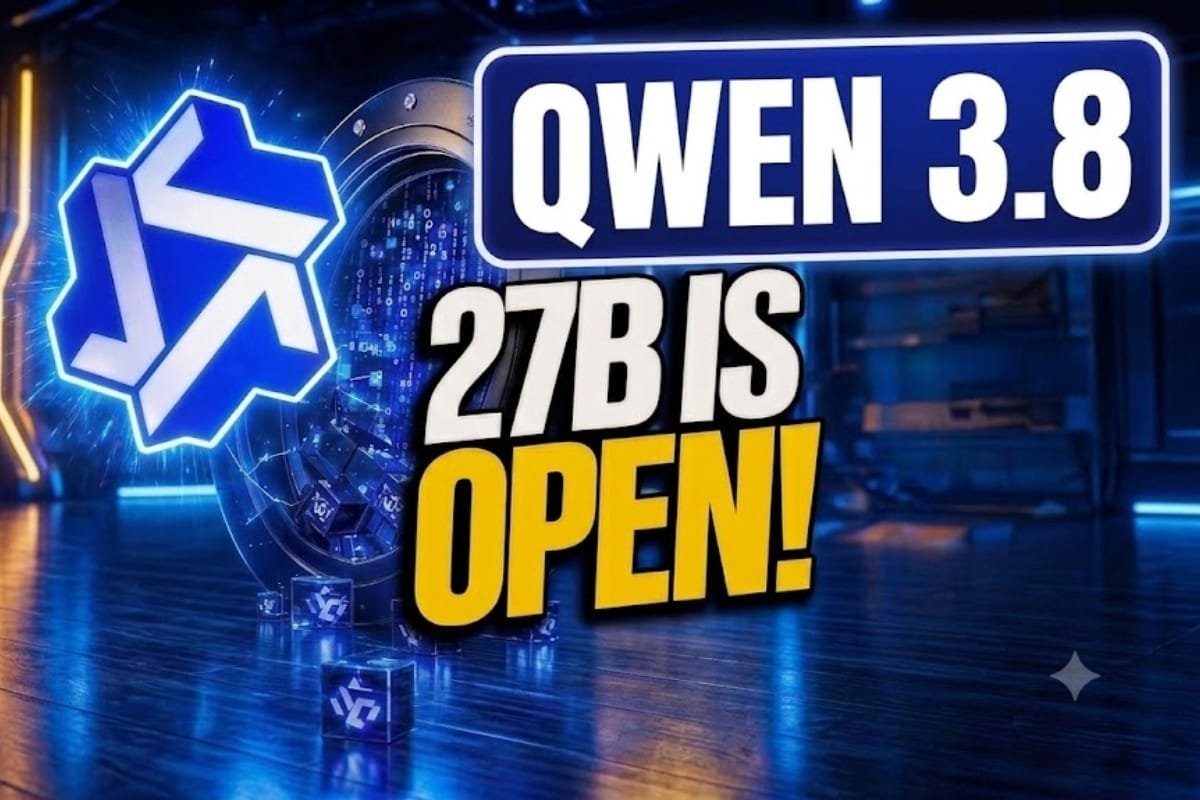
Alibaba’s Qwen team has officially dropped its newest generation of artificial intelligence models: Qwen3.8-Max and Qwen3.8 27B.
On paper, Qwen3.8-Max is the massive flagship headline. It boasts a 2.4-trillion-parameter sparse Mixture-of-Experts (MoE) engine designed for autonomous multi-day research and massive agentic coding tasks in the cloud. Yet, across developer forums, & local AI communities, the real uproar is entirely about Qwen3.8 27B.
While Qwen3.8-Max showcases what is possible when you throw thousands of cloud GPUs at a problem, Qwen3.8 27B represents a monumental generational leap for local AI. It delivers a level of raw intelligence, architectural efficiency, and tool-use precision on local hardware that used to require massive multi-GPU server setups or closed cloud APIs.
Meet Qwen3.8-Max: A New Bar for Coding and Cowork. pic.twitter.com/mJaA8vr6xT
— Qwen (@Alibaba_Qwen) August 3, 2026
Table of Contents
Two Models
The Qwen3.8 release spans two completely different tiers of computing:
| Feature / Spec | Qwen3.8-Max | Qwen3.8 27B |
| Model Size | ~2.4 Trillion Parameters (MoE) | 27 Billion Parameters |
| Active Parameters | ~95 Billion per token | 27 Billion |
| Deployment | Cloud API / Hosted Endpoints | Open Weights / Fully Local Execution |
| Hardware Requirements | Massive GPU Clusters | 16GB – 17GB VRAM / Unified Memory |
| Primary Focus | Autonomous multi-day research | High-speed local coding, private agents & fine-tuning |
| Access Model | Pay-per-token Cloud API | Open Weights / Free Local Use |
While Qwen3.8-Max is undoubtedly impressive and poses strong competition to frontier heavyweights like Claude Opus 4.8, Claude Fable 5, Gemini 3.1-Pro, and GPT-5.6 Sol (max), it still has a long way to go before it can completely overtake or beat them across every core software engineering benchmark.

Qwen3.8 27B: Why the AI community is Excited
To understand why the hype around Qwen3.8 27B is deafening, you have to look at what local models used to look like versus what this 27B architecture actually achieves.
Historically, running models locally meant accepting heavy compromises. Older 7B and 14B models were fast but fragile—frequently hallucinating on complex syntax, dropping instructions in long prompts, and failing at multi-step reasoning. Previous-generation 27B–34B models were better, but they felt sluggish and still lagged far behind closed cloud models on coding and agentic loops.
While Qwen3.8-Max is available via cloud API starting today, the real shockwave is that Alibaba is officially dropping the open weights for Qwen3.8 27B in the second week of August—giving developers total freedom to run it locally
Quantum Leap Over Older Qwen Generations
Compared to earlier iterations like Qwen1.5 or Qwen2.5 14B/32B, Qwen3.8 27B introduces fundamental architectural refinements:
- Drastically Improved Reasoning-to-Size Ratio: It matches or outperforms older, significantly larger 70B open models across coding, math, and logical benchmarks while requiring a fraction of the compute.
- Refined Context Recall: Older local models claimed long context windows but suffered from “lost in the middle” memory degradation. Qwen3.8 27B maintains sharp retrieval accuracy across massive file inputs and long system prompts.
- Native Agentic & Function Calling Precision: Earlier open weights frequently broke structured JSON outputs or failed mid-way through multi-step terminal tool calls. Qwen3.8 27B behaves like a true autonomous agent locally, executing terminal commands and parsing API responses reliably.
Outperforming the Local Competition in the 20B–35B Weight Class
In the open-weights space, the 20B-to-35B parameter class is considered the absolute “golden sweet spot.” It represents the maximum power you can squeeze onto a single consumer workstation.
Where older competitors like Llama-3 8B felt too light and 70B models required dual-GPU setups, Qwen3.8 27B dominates the mid-sized field:
- Superior Code Generation: It writes production-grade, highly structured multi-file code out of the box rather than simple snippet autocompletes.
- Multimodal Intelligence: Unlike legacy text-only local checkpoints, Qwen3.8 27B processes visual inputs natively, allowing developers to feed UI mockups, architecture diagrams, and error screenshots directly into their local workflow.
- Extreme Quantization Resilience: Through advanced post-training, the model retains nearly all of its FP16 reasoning power even when squeezed into 4-bit (
Q4_K_M) or 6-bit quants.
The Magic Hardware Profile: Frontier Power in ~17GB VRAM
The most explosive aspect of Qwen3.8 27B is its hardware profile.
It is engineered to fit into a 16GB to 17GB memory footprint. That exact number is crucial because it aligns perfectly with accessible consumer hardware:
- Nvidia RTX 4070 Ti / 5070 Ti (16GB VRAM)
- Apple Silicon Macs (M-series with 24GB or 32GB Unified Memory)
- Single-card Developer Workstations
Running a model locally at 20+ tokens per second with zero token cost, zero rate limits, and zero latency latency transforms what a developer can do locally on a laptop.
Zero API Costs, Total Data Privacy, and Ecosystem Readiness
Because Qwen3.8 27B runs entirely on local silicon, it unlocks advantages cloud APIs simply cannot offer:
- Complete Privacy for Proprietary Code: Internal repositories, legal contracts, and sensitive database schemas never leave the local machine or air-gapped network.
- Infinite Agentic Loops: You can let local coding agents run thousands of self-correcting test-and-debug loops overnight without coming back to a $200 cloud API bill.
- Immediate Open-Source Tooling Support: The ecosystem reacted instantly. Fine-tuning frameworks like Unsloth prepared custom quantization kernels, while Llama.cpp and Ollama made single-command deployment possible (
ollama run qwen3.8:27b).
Where Qwen3.8 27B Slots In Immediately
Because of its advanced capabilities and light hardware requirement, Qwen3.8 27B instantly becomes the top choice for practical local use cases:
- Local IDE Integration: Paired with tools like VS Code or Continue.dev, it acts as a zero-latency, private inline code assistant that understands full codebase contexts.
- Autonomous Local CLI Agents: Executing multi-step shell scripts, running local unit tests, and refactoring directory structures autonomously on your local filesystem.
- Private Document & Codebase RAG: Ingesting confidential internal documentation, PDFs, and codebase repositories locally without third-party data logging risks.
- Air-Gapped Enterprise Workflows: Deploying behind strict corporate firewalls in financial, medical, or defense sectors where cloud access is strictly prohibited.
Final Verdict: The New Benchmark for Local AI
Qwen3.8-Max demonstrates the impressive ceiling of modern cloud AI systems. However, Qwen3.8 27B represents a true milestone for local AI ownership.
By delivering near-frontier coding logic, native multimodal processing, and bulletproof tool calling inside a compact ~17GB hardware envelope, Alibaba didn’t just release another model—they set a massive new benchmark for what developers can run locally. That is precisely why Qwen3.8 27B is stealing the spotlight.
Get real time update about this category directly on your device, subscribe now.
Have any thoughts?
Share your reaction or leave a quick response — we’d love to hear what you think!
-
 1
1 - 0
- 0
- 0
- 0
- 0