Table of Contents
You finally lie down after a long day, ready to sleep.
But instead of resting, your brain suddenly becomes louder.
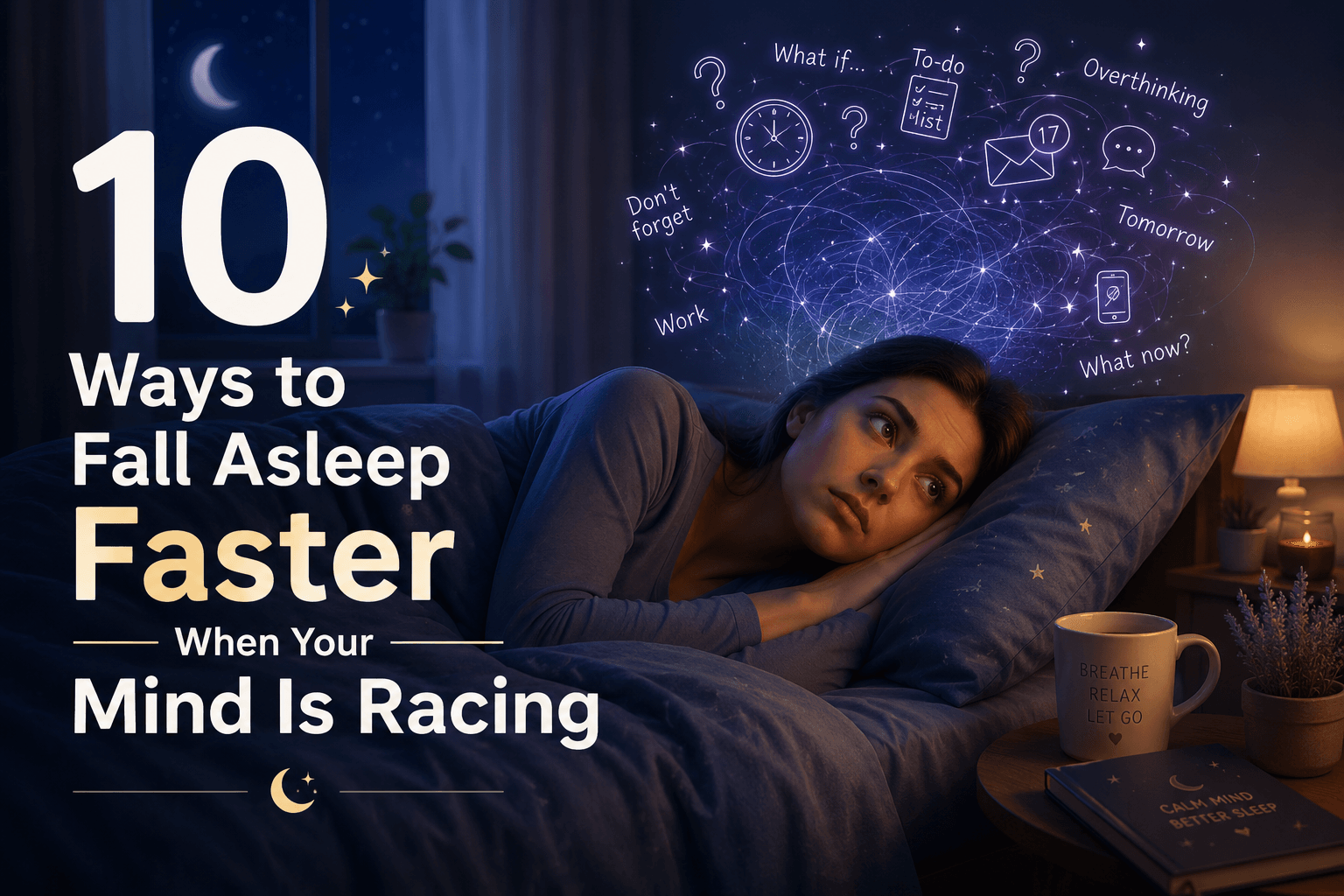
You replay conversations. Think about tomorrow’s tasks. Overanalyze mistakes from years ago. Create imaginary scenarios. Check the time again. Panic because you’re still awake.
If this sounds familiar, you’re not alone.
Millions of people struggle to sleep with racing thoughts, especially in today’s overstimulated, screen-heavy world. According to the Centers for Disease Control and Prevention (CDC), more than 1 in 3 adults do not get enough sleep regularly. Sleep deprivation has also been linked to anxiety, depression, poor concentration, and heart disease.
The good news?
You can train your brain and body to relax faster at night.
This guide covers 10 practical and science-backed ways to fall asleep quicker, especially when you can’t stop overthinking at night.
Why Your Mind Races at Night

During the day, your brain is distracted by work, studies, notifications, conversations, and responsibilities.
At night, everything becomes quiet.
That silence gives unresolved thoughts room to surface.
Researchers studying insomnia found that racing thoughts at bedtime are strongly associated with sleep-onset insomnia ,difficulty falling asleep. A 2021 study published in Comprehensive Psychiatry showed that bedtime racing thoughts may contribute more directly to insomnia severity than general worrying or rumination.
Modern lifestyles make the problem worse:
- Constant phone use
- Doomscrolling before bed
- Academic and work stress
- Social media overstimulation
- Irregular sleep schedules
- High caffeine intake
Your brain stays in “problem-solving mode” when it should be slowing down.
Why Overthinking Disrupts Sleep

Sleep requires your nervous system to relax.
But overthinking activates mental alertness and stress hormones like cortisol.
This creates a cycle:
- You can’t sleep
- You become anxious about not sleeping
- Anxiety increases alertness
- Falling asleep becomes even harder
Experts call this “pre-sleep arousal.”
According to sleep specialists at the Cleveland Clinic, calming the mind before bed is one of the most important parts of healthy sleep hygiene.
The10 Ways to Fall Asleep Fast
1. Do a “Brain Dump” Before Bed
One of the fastest ways to reduce mental clutter is to write everything down.
Spend 5–10 minutes journaling:
- Tasks for tomorrow
- Worries
- Random thoughts
- RemindersEmotions
This tells your brain:
“I don’t need to keep remembering this.”
Sleep psychologists often recommend journaling because it reduces cognitive overload and bedtime anxiety.
Try This:
Keep a notebook beside your bed and write:
- “What’s stressing me?”
- “What can wait until tomorrow?”
- “What is actually in my control?”
2. Use the 4-7-8 Breathing Method
Breathing exercises slow your heart rate and activate the parasympathetic nervous system.
The 4-7-8 technique is simple:
- Inhale for 4 seconds
- Hold for 7 seconds
- Exhale slowly for 8 seconds
Repeat 4–8 times.
This method helps your body shift from alert mode into relaxation mode.
Many people notice they fall asleep quicker after controlled breathing because it reduces physical tension.
3. Stop Looking at the Clock
Checking the time repeatedly increases sleep anxiety.
You start calculating:
- “I only have 5 hours left.”
- “I’ll be exhausted tomorrow.”
That pressure keeps the brain alert.
Instead:
- Turn the clock away
- Avoid checking your phone
- Focus on relaxation instead of sleep performance
Sleep experts consistently recommend removing visible clocks from bedrooms for this reason.
4. Keep Your Bedroom Cool and Dark
Your body naturally lowers its temperature before sleep.
A cooler environment supports melatonin production and deeper sleep.
According to the CDC, a quiet, dark, and comfortable room improves sleep quality significantly.
Ideal Sleep Environment:
- Cool temperature
- Minimal noise
- Blackout curtains
- Dim lighting
- Comfortable bedding
Even small environmental changes can improve insomnia symptoms.
5. Avoid Blue Light Before Bed
Scrolling on TikTok or Instagram may feel relaxing, but your brain disagrees.
Phones emit blue light that suppresses melatonin ,the hormone responsible for sleep.
Social media also overstimulates the brain emotionally.
You go from:
you go from:
- Funny videos
- News updates
- Emotional content
- Stressful comparisons
…directly into bed.
That transition confuses your nervous system
Better Alternatives:
- Reading
- Soft music
- Audiobooks
- Guided meditation
- Stretching
Experts recommend limiting screens at least 30–60 minutes before sleep.
6. Try Progressive Muscle Relaxation
Overthinking is often connected to physical tension.
Progressive muscle relaxation helps release stored stress.
How It Works:
Tense each muscle group for 5 seconds, then relax.
Start from:
- Toes
- Legs
- Stomach
- Hands
- Shoulders
- Jaw
This technique helps redirect attention away from anxious thoughts.
The Cleveland Clinic specifically recommends progressive muscle relaxation for calming racing thoughts before bed.
7. Use Cognitive Shuffling
Cognitive shuffling is a newer sleep technique gaining popularity online.
Instead of trying to “stop thinking,” you gently distract the brain with random neutral words.
Example: Apple → Train → Blanket → River → Cloud
This mimics the random thought patterns your brain naturally produces before sleep.
It prevents deep emotional thinking loops.
Many people who can’t stop overthinking at night find this technique surprisingly effective because it reduces mental intensity without forcing silence.
8. Don’t Stay in Bed Awake for Hours
If you’ve been awake for around 20 minutes, get up briefly.
Why?
Because your brain can start associating the bed with stress and frustration.
Instead:
- Sit somewhere dimly lit
- Read something calming
- Listen to quiet audio
- Avoid screens
Return to bed only when sleepy again.
This approach is commonly used in Cognitive Behavioral Therapy for Insomnia (CBT-I), one of the most effective non-medication treatments for insomnia.
9. Watch Your Caffeine Timing
Caffeine stays in your system longer than most people realize.
For some individuals, afternoon coffee can still affect nighttime sleep.
Hidden Caffeine Sources:
- Energy drinks
- Matcha
- Chocolate
- Soda
- Pre-workout supplements
If you struggle to fall asleep fast, try reducing caffeine after 2 PM.
10. Create a Consistent Sleep Routine
Your brain loves predictability.
Going to bed at random hours confuses your circadian rhythm.
According to sleep experts, consistency is one of the strongest predictors of better sleep quality.
A Better Routine:
- Sleep and wake at similar times daily
- Dim lights 1 hour before bed
- Avoid heavy meals late at night
- Exercise earlier in the day
- Keep bedtime relaxing
Consistency trains your body to expect sleep.
Habits That Secretly Make Insomnia Worse

Sometimes the problem isn’t what you’re doing at bedtime.
It’s what you’re doing all day.
Common Sleep Disruptors
- Doomscrolling
- Irregular sleep schedules
- High stress levels
- Late-night studying or work
- Excess caffeine
- Long naps
- Sleeping with TV on
- Overchecking sleep apps
According to sleep research, stress sensitivity can magnify how racing thoughts disrupt sleep quality.
When to See a Doctor
Occasional sleeplessness is normal.
But persistent insomnia may require professional help.
See a healthcare provider if:
- Sleep problems last more than 3 weeksYou feel exhausted daily
- Anxiety worsens
- You snore heavily or stop breathing during sleep
- Sleep affects work or studies
The National Heart, Lung, and Blood Institute explains that sleep studies can help diagnose conditions like insomnia and sleep apnea.
FAQ
1. Why does my brain race more at night?
Nighttime removes distractions, making unresolved stress and thoughts more noticeable. Stress hormones and screen overstimulation can also increase mental alertness.
2. How can I fall asleep in 5 minutes?
While instant sleep is unrealistic for most people, breathing exercises, progressive muscle relaxation, and reducing screen exposure can help you fall asleep faster.
3. Is overthinking at night a sign of anxiety?
Sometimes. Racing thoughts can be linked to stress, anxiety, or insomnia, but occasional overthinking is common.
4. Should I stay in bed if I can’t sleep?
No. Sleep experts recommend getting up briefly if you stay awake too long to avoid associating the bed with stress.
5. Does melatonin help with racing thoughts?
Melatonin may help regulate sleep timing, but it does not directly stop anxious thinking. Behavioral techniques are often more effective.
6. Can phones cause insomnia?
Yes. Blue light and emotional overstimulation from phones can delay melatonin release and increase alertness.
7. What is the best natural remedy for insomnia?
There is no universal solution, but consistent sleep routines, relaxation exercises, journaling, and limiting caffeine are among the most evidence-backed insomnia tips.
Conclusion: How to Fall Asleep Fast Starts With Calming the Mind
Learning how to fall asleep fast is not about forcing sleep.
It’s about creating the right conditions for your brain and body to relax naturally.
If you struggle to sleep with racing thoughts, start small:
- Put the phone away earlier
- Try breathing exercises
- Write your thoughts down
- Keep a consistent routine
You do not need a perfect nighttime routine overnight.
Even one or two changes can help you fall asleep quicker and wake up feeling more rested.
Better sleep is a skill and like any skill, it improves with practice.
Call-to-Action
Have racing thoughts ever kept you awake for hours?
Try one of these techniques tonight and see which works best for you. If you found this guide helpful, share it with someone else who can’t stop overthinking at night.