Suddham Sen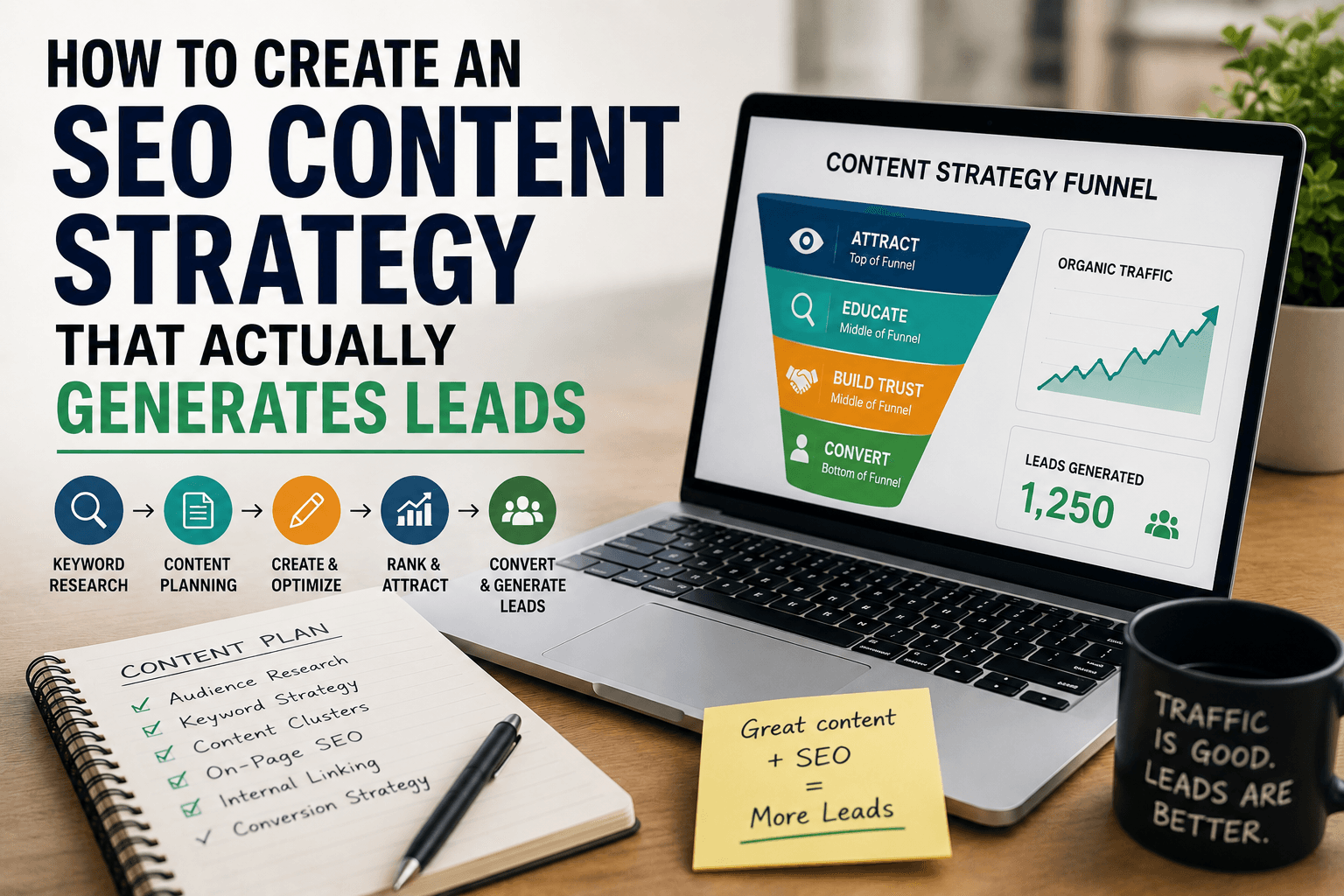
Table of Contents
SEO isn’t just about getting more people to your website. It’s about getting the right people there—and giving them a reason to take the next step.
A page can rank on Google, attract thousands of visitors and still generate almost no business.
That is the part of SEO content strategy many businesses get wrong.
They focus on keywords, search volume, rankings and traffic, but forget the most important question:
What happens after someone lands on the page?
A strong SEO content strategy should do more than increase organic traffic. It should attract people who have a genuine problem, answer their questions, establish your expertise and move them closer to becoming a customer.
For businesses in India, this is particularly important. Search behaviour varies widely across industries, cities, languages and customer segments. Someone searching for “best digital marketing agency in Bangalore” is in a very different stage of the buying journey from someone searching “how does SEO work?”
Both searches can bring traffic.
Only one may bring a sales opportunity.
This guide explains how to build an SEO content strategy that generates leads, from keyword research and search intent to landing pages, blog content, internal linking, calls to action and ongoing optimisation.
What Is an SEO Content Strategy?
An SEO content strategy is a structured plan for creating, optimising and connecting content so that it can rank in search engines while also supporting business objectives.
Those objectives could include:
- Generating qualified leads
- Increasing enquiries
- Driving demo or consultation bookings
- Growing organic traffic
- Building topical authority
- Increasing product or service discovery
- Supporting sales conversations
- Improving brand visibility
- Capturing users at different stages of the buying journey
The key distinction is this:
SEO content is not successful simply because it ranks.
It is successful when the traffic it generates contributes to a meaningful business outcome.
That means your SEO strategy needs to connect three things:
Search demand → Useful content → Conversion opportunity
If one of those is missing, the strategy becomes weaker.
Step 1: Start With Your Business, Not Your Keywords
One of the easiest mistakes to make is opening an SEO tool and immediately looking for keywords with high search volume.
Don’t.
Before researching keywords, understand what the business actually wants to sell.
Start by identifying:
Your core products or services
What does the company make money from?
For an agency, for example, that might include:
- SEO services
- Content marketing
- Website development
- Performance marketing
- Social media marketing
- Technical SEO
- Local SEO
For a SaaS company, the list might look completely different.
Your highest-value customers
Not every visitor has equal commercial value.
Identify:
- Who typically buys?
- What industries do they belong to?
- What problems do they have?
- What triggers them to start searching?
- What objections stop them from purchasing?
- What questions do they ask before contacting you?
This information becomes the foundation for your content strategy.
Your conversion goals
Decide what you want visitors to do.
For example:
Primary conversion
Request a consultation
Secondary conversions
Download a guide
Book a demo
Submit an enquiry
Call the business
Request pricing
Subscribe to updates
Without defined conversion goals, it becomes difficult to determine whether your SEO content is actually working.
Step 2: Build Keyword Research Around Search Intent
Keyword research is still fundamental to SEO.
But search volume alone isn’t enough.
You need to understand why someone is searching.
Consider these searches:
- “what is technical SEO”
- “technical SEO checklist”
- “technical SEO agency”
- “technical SEO services”
- “best technical SEO agency in India”
They are all related.
But they represent very different levels of intent.
Someone searching “what is technical SEO” is likely looking for information.
Someone searching “technical SEO services” may be evaluating providers.
Someone searching “best technical SEO agency in India” is much closer to making a commercial decision.
That distinction should influence the content you create.
The Four Main Types of Search Intent
1. Informational Intent
The user wants to learn something.
Examples:
- What is SEO?
- How does content marketing work?
- What is technical SEO?
- How to improve website rankings
Best content formats:
- Blog posts
- Guides
- Tutorials
- Explainers
- Checklists
2. Commercial Investigation
The user is researching their options.
Examples:
- Best SEO agencies in India
- SEO tools for small businesses
- SEO agency vs freelancer
- Best CRM for startups
Best content formats:
- Comparisons
- Reviews
- Buying guides
- Service explainers
- Case studies
3. Transactional Intent
The user is ready to take action.
Examples:
- SEO services
- Hire SEO agency
- Digital marketing agency Mumbai
- SEO consultant India
Best content formats:
- Service pages
- Product pages
- Landing pages
- Pricing pages
- Consultation pages
4. Navigational Intent
The user is looking for a specific website or brand.
Examples:
- Mag Digit
- Mag Digit SEO services
- Mag Digit contact
These searches are generally addressed through your brand and website architecture rather than a separate content campaign.
Step 3: Create Keyword Clusters Instead of Individual Blog Posts
A common SEO mistake is treating every keyword as a separate article.
Instead, build keyword clusters.
Suppose your primary topic is:
SEO content strategy
You could build a content cluster around:
- SEO content strategy
- SEO content strategy for small business
- SEO content planning
- SEO content calendar
- SEO keyword research
- SEO content writing
- content strategy for SEO
- SEO blog strategy
- content marketing and SEO
- SEO content strategy examples
You don’t necessarily need ten separate articles.
Some of these keywords may belong naturally on one comprehensive page.
Others could become supporting articles.
This creates a stronger topic cluster and gives you opportunities to internally link related content.
Step 4: Build a Content Funnel
If every article on your website is aimed at generating an immediate enquiry, the content can feel overly sales-driven.
If every article is purely informational, you may generate traffic without generating leads.
The solution is to build content for different stages of the buyer journey.
Top of Funnel: Awareness
These users are identifying a problem.
Examples:
- What is technical SEO?
- Why is my website traffic dropping?
- How does Google ranking work?
- How to create a content strategy
The objective here is to educate and build awareness.
Middle of Funnel: Consideration
These users understand the problem and are exploring solutions.
Examples:
- SEO agency vs in-house SEO
- How much does SEO cost in India?
- SEO audit checklist
- Best SEO strategy for small businesses
- How to choose an SEO agency
The objective is to build trust and demonstrate expertise.
Bottom of Funnel: Decision
These users are looking for a provider, product or solution.
Examples:
- SEO agency in India
- Technical SEO services
- Local SEO services
- Content marketing agency
- SEO consultation
The objective is to convert existing intent into an enquiry.
Step 5: Don’t Make Your Blog Do the Job of a Service Page
This is a surprisingly common problem.
A company wants to rank for:
SEO services
So it publishes a 2,500-word blog called:
“Everything You Need to Know About SEO Services.”
But the page isn’t designed to sell the service.
There is no:
- Clear service proposition
- Process
- Relevant case study
- Pricing guidance
- Proof of expertise
- Strong CTA
- Contact opportunity
Even if the article attracts visitors, it may not generate many enquiries.
Instead, create a dedicated SEO services page targeting the commercial intent.
Then use blog content to support it.
For example:
Service page
SEO Services
Supported by:
How Much Does SEO Cost in India?
Technical SEO Checklist
How Long Does SEO Take to Work?
On-Page SEO: What Actually Matters?
SEO vs PPC: Which Should Your Business Invest In?
Those articles can then link naturally back to the relevant service page.
Step 6: Create Landing Pages for High-Intent Searches
Your website shouldn’t rely entirely on the homepage to rank for everything.
Create dedicated landing pages for important commercial topics.
Depending on the business, this could include:
- SEO services
- Technical SEO
- Local SEO
- E-commerce SEO
- Content marketing
- Website development
- Industry-specific services
- Location-specific services
For example, instead of trying to make one generic page rank for every variation of:
SEO agency
SEO services
SEO company
SEO consultant
SEO agency India
You can build a logical website structure where each important service has a clear purpose.
This also creates a better user experience.
Someone searching for technical SEO shouldn’t have to land on your homepage and hunt around for information.
Step 7: Make Every Blog Post Have a Conversion Path
This is where SEO content starts becoming lead-generation content.
A blog shouldn’t end with:
“We hope you found this article useful.”
That’s a dead end.
Instead, ask:
What would this reader logically want to do next?
If you’re writing:
“How to Improve Your Website’s Technical SEO”
The next step could be:
Not sure what’s holding your website back? Get a technical SEO audit.
If you’re writing:
“How Much Does SEO Cost in India?”
The CTA could be:
Want to understand what an SEO strategy would look like for your business? Speak with our team.
If you’re writing:
“How to Create an SEO Content Strategy”
The next step could be:
Need help turning your keyword research into a content strategy? Let’s build one around your business goals.
The CTA should feel like the next logical step, not an interruption.
Step 8: Optimise the Page Beyond the Keyword
Having the keyword in the article isn’t enough.
Every important page should be reviewed for on-page SEO.
That includes:
Title tag
Clearly communicate what the page is about while incorporating the primary keyword naturally.
Meta description
Give users a reason to click.
H1
Use one clear primary heading that accurately describes the page.
H2 and H3 headings
Break the content into logical sections and incorporate relevant subtopics naturally.
URL
Keep it concise, descriptive and readable.
For example:
/seo-content-strategy/
is generally clearer than:
/blog/post?id=1837
Image optimisation
Images should have:
- Descriptive file names
- Relevant alt text where appropriate
- Appropriate dimensions
- Compressed file sizes
Internal links
Connect the article to relevant service pages and supporting content.
External references
Where appropriate, reference authoritative sources rather than making unsupported claims.
Step 9: Use Internal Linking as a Lead Generation Tool
Internal linking isn’t just an SEO technique.
It also controls where users go next.
Imagine someone reads:
“How Much Does SEO Cost in India?”
Inside the article, you link to:
SEO Services
Then from the SEO service page, they see:
Technical SEO
Content Marketing
Local SEO
Request a Consultation
The visitor has gone from:
Question → Education → Solution → Service → Enquiry
That’s exactly what your content architecture should facilitate.
Step 10: Create Content Around Real Customer Questions
Some of your best SEO content ideas may not come from an SEO tool.
Talk to:
- Sales teams
- Customer support
- Business owners
- Existing customers
- Account managers
Ask:
What questions do prospects ask before buying?
You’ll often uncover excellent content opportunities.
For example:
- How long does SEO take?
- How much does SEO cost?
- Can SEO work for a new website?
- Should I hire an agency or freelancer?
- Why isn’t my website ranking?
- How many blogs should I publish per month?
- Does blogging actually help SEO?
- Can SEO generate leads for B2B companies?
These questions have a commercial connection because they occur during the buying process.
Step 11: Don’t Chase Search Volume at the Expense of Relevance
A keyword with 50,000 searches isn’t automatically better than one with 500.
Suppose:
Keyword A: 50,000 monthly searches
Keyword B: 800 monthly searches
If Keyword A is extremely broad and attracts an audience that has no interest in your service, its business value may be limited.
Keyword B might be much more commercially relevant.
For lead generation, ask:
If someone searches this keyword and lands on our website, is there a realistic reason for them to become a customer?
That question should sit alongside search volume and keyword difficulty.
Step 12: Use Search Data to Find Content Gaps
Once your website has enough data, Google Search Console and SEO platforms can show you queries where your pages are already appearing.
Look for keywords where:
- You have impressions but few clicks
- You rank on page two
- A page ranks for an unexpected keyword
- A page ranks for multiple related queries
- Search intent has changed
- A page receives traffic but doesn’t convert
These are optimisation opportunities.
You don’t always need another blog.
Sometimes the best SEO strategy is to improve an existing page.
Step 13: Turn Existing Traffic Into More Leads
This is where SEO and CRO—conversion rate optimisation—meet.
Suppose a blog receives 1,000 organic visitors every month but produces almost no enquiries.
Before writing another ten articles, investigate the page.
Ask:
- Is the content actually relevant to our services?
- Does the page answer the user’s question?
- Is there a clear CTA?
- Is the CTA visible?
- Are there internal links?
- Does the page establish credibility?
- Is there a relevant service page?
- Is the next step obvious?
- Does the page load quickly?
- Is the mobile experience good?
You may be sitting on valuable organic traffic without realising it.
Step 14: Build Topic Clusters Around Your Money Pages
Your highest-value commercial pages should have supporting content around them.
For example:
Core page
SEO Services
Supporting content
- What Is SEO?
- How Does SEO Work?
- How Much Does SEO Cost in India?
- How Long Does SEO Take?
- Technical SEO Checklist
- On-Page SEO Checklist
- SEO Content Strategy Guide
- SEO vs PPC
- How to Choose an SEO Agency
- Common SEO Mistakes
Each supporting article can link back to the relevant commercial page where appropriate.
Over time, this creates a connected content ecosystem rather than a random collection of blog posts.
Step 15: Make Your Content Demonstrate Experience
Generic information is everywhere.
Your content needs a reason to be trusted.
Instead of simply saying:
“SEO is important for businesses.”
Show what you have actually seen.
Use:
- Real examples
- Campaign experiences
- Before-and-after observations
- Screenshots where appropriate
- Case studies
- Original research
- Practical processes
- Lessons from projects
- Expert commentary
If you have worked on websites that struggled with technical SEO, explain the problems you encountered and how they were addressed.
That’s much more useful than another generic definition of crawlability.
Step 16: Measure Leads, Not Just Rankings
A proper SEO reporting system should go beyond:
“We moved from position 12 to position 7.”
Track the relationship between SEO and business outcomes.
SEO metrics
- Organic clicks
- Organic impressions
- Keyword rankings
- Ranking distribution
- Organic traffic
- Indexed pages
- Click-through rate
- Organic landing pages
Engagement metrics
- Engaged sessions
- Engagement rate
- Landing-page performance
- User journeys
Lead-generation metrics
- Form submissions
- Calls
- Consultation requests
- Demo bookings
- Enquiries
- Lead conversion rate
- Qualified organic leads
Business metrics
- Cost per organic lead
- Lead quality
- Sales opportunities
- Revenue influenced by organic search
The exact metrics will depend on the business and its analytics setup, but the principle is simple:
Traffic is an SEO metric. Leads are a business metric.
An SEO Content Strategy That Generates Leads: The Simple Framework
A useful way to think about your entire strategy is:
1. Identify the customer
Who are you trying to attract?
↓
2. Identify the problem
What are they trying to solve?
↓
3. Identify the search
What would they type into Google?
↓
4. Identify the intent
Are they learning, comparing or ready to buy?
↓
5. Create the right page
Blog? Guide? Service page? Landing page? Comparison?
↓
6. Optimise it
Keywords, headings, metadata, URLs, images, internal links and technical SEO.
↓
7. Create the next step
CTA, service page, consultation, demo or enquiry.
↓
8. Measure what happened
Rankings → Traffic → Engagement → Leads → Revenue
That is the difference between publishing content and building an SEO content strategy.
How Often Should You Publish SEO Content?
There isn’t a magic number of blog posts that guarantees SEO results.
Publishing four excellent articles is not necessarily better than publishing eight mediocre ones—or vice versa.
Your publishing frequency should depend on:
- Search demand
- Competition
- Available expertise
- Existing content gaps
- Website authority
- Commercial priorities
- Content production capacity
- How quickly existing content can be updated
For many businesses, a smaller number of highly relevant, well-researched pieces can be more useful than publishing large volumes of generic articles.
The goal isn’t to fill your blog.
The goal is to build useful search assets that continue attracting the right audience.
Common SEO Content Strategy Mistakes to Avoid
Writing for keywords instead of people
A keyword should help you understand what users want—not dictate awkward sentences.
Creating a new page for every keyword variation
Similar search queries often belong on the same comprehensive page.
Creating dozens of near-identical pages can create unnecessary duplication and make your website harder to manage.
Publishing blogs with no commercial connection
Traffic that can never become a customer isn’t necessarily valuable traffic.
Ignoring existing content
Some of your easiest SEO wins may already exist on your website.
Update, expand and improve pages before automatically creating new ones.
Treating rankings as the final objective
Ranking #1 is useful.
But if nobody clicks, nobody engages and nobody enquires, the ranking isn’t doing much for the business.
Making every CTA “Contact Us”
Different users need different next steps.
Consider:
- Read a related guide
- View a case study
- Explore a service
- Download a resource
- Book a consultation
- Request an audit
Make the CTA match the user’s stage of intent.
The Real Goal of SEO Content
SEO content shouldn’t exist simply because “Google likes fresh content.”
It should exist because your customers have questions, problems and decisions to make.
The strongest strategy connects those questions to your expertise.
Someone discovers your brand through an informational search.
They find another useful article through internal links.
They discover your service.
They read a case study.
They understand your approach.
Then, when they’re ready to buy, your company is already familiar.
That’s the real value of SEO content.
You aren’t simply trying to rank an article. You’re building a path from search query to customer.
And when keyword research, search intent, content quality, technical SEO, internal linking and conversion strategy work together, organic search can become much more than a traffic channel.
It can become a repeatable lead-generation engine for your business.
Get real time update about this category directly on your device, subscribe now.