Suddham Sen
AI chatbots are becoming an important part of how businesses handle customer inquiries, qualify leads, provide support, and automate routine conversations. From answering product questions on a website to helping customers navigate complex services, a well-designed chatbot can improve how businesses interact with their audiences.
However, launching an effective AI chatbot involves more than choosing a tool and adding a chat window to a website. Businesses need to consider their use cases, data sources, integrations, security requirements, ongoing maintenance, and expected return on investment.
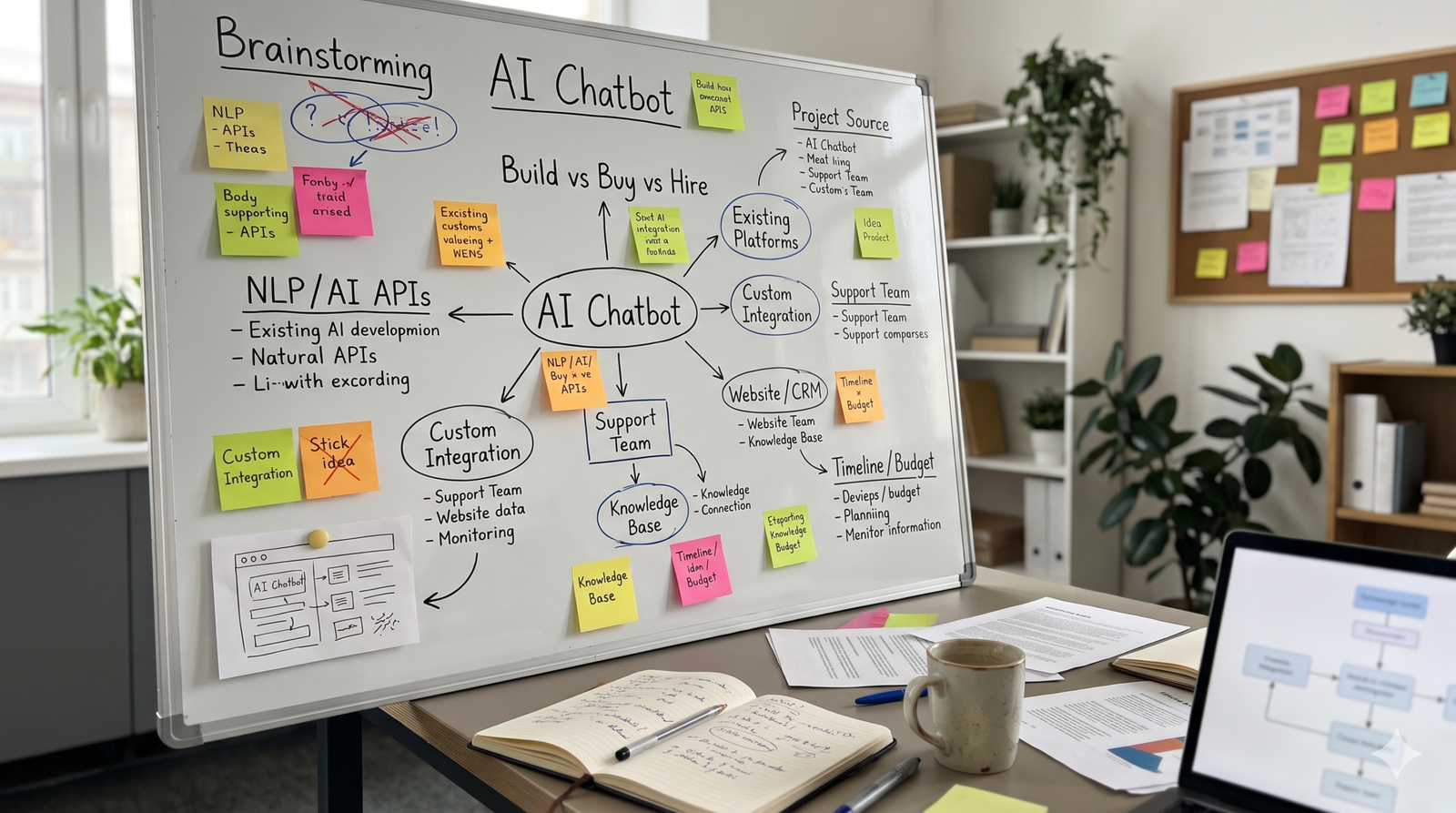
One of the biggest decisions is whether to build a chatbot in-house, buy an existing chatbot platform, or hire an agency that provides AI chatbot development services.
Each approach offers different levels of control, customization, implementation effort, and long-term responsibility. The right choice depends on your business goals, technical capabilities, budget, and the complexity of the chatbot you need.
This guide compares all three options to help you choose the right approach for your business.
Table of Contents
What Are AI Chatbot Development Services?
AI chatbot development services involve designing, building, integrating, deploying, and maintaining chatbots that use artificial intelligence to interact with users.
Unlike traditional rule-based chatbots that follow fixed decision trees, AI chatbots can use technologies such as natural language processing (NLP), machine learning, large language models (LLMs), and retrieval-based systems to interpret user messages and generate relevant responses.
The exact capabilities depend on how the chatbot is designed. Some bots answer questions using approved business information, while others can retrieve account details, qualify leads, create support tickets, or trigger actions through connected applications.
Professional chatbot development services may include:
- Business requirement analysis and chatbot strategy.
- Conversation design and user experience planning.
- AI model and platform selection.
- Integration with websites, CRM systems, help desks, and internal databases.
- Knowledge base preparation and retrieval configuration.
- Security, testing, and deployment.
- Performance monitoring, optimization, and ongoing maintenance.
For example, an e-commerce company might use an AI chatbot to answer product questions, explain delivery policies, and help customers track orders. A B2B software company might use one to qualify website visitors, explain product features, and route qualified leads to the sales team.
The objective is not simply to make conversations automated. It is to create a useful, reliable experience that supports a specific business process.
Why Businesses Invest in AI Chatbot Development
Businesses explore AI chatbot solutions for several operational and customer experience goals.
Faster responses: A chatbot can respond to supported questions without requiring a human agent to handle every initial interaction.
Lead qualification: Chatbots can ask relevant questions, collect contact details with appropriate consent, and route potential customers to the sales team.
Customer support automation: A chatbot can answer common questions, provide approved troubleshooting guidance, and direct complex issues to human agents.
Consistent information: When connected to a well-maintained knowledge base, a chatbot can provide standardized answers about products, services, policies, and procedures.
Business system integration: Depending on its permissions and integrations, a chatbot can retrieve information or initiate actions in CRM, help desk, booking, or other business systems.
Conversation insights: Chatbot analytics can help identify common questions, recurring problems, and gaps in website content or support documentation.
These benefits depend on the chatbot’s design, the quality of its information, and how well it fits the existing customer journey. A poorly configured chatbot can create frustration instead of reducing support workload.
Option 1: Build an AI Chatbot In-House
Building an AI chatbot in-house means your internal team takes primary responsibility for its design, development, integration, and ongoing operation.
Your team may develop a custom application using AI APIs, open-source frameworks, retrieval systems, and your existing technology stack. You can also build on a platform while retaining responsibility for the core implementation.
Advantages of Building In-House
Greater control over customization: Your team can tailor conversation flows, business logic, integrations, and user experiences to your exact requirements.
Control over architecture: You can choose the technologies, data flows, deployment approach, and monitoring systems that fit your existing environment.
Direct access to internal expertise: Developers and domain experts can collaborate closely on specialized workflows and business requirements.
Potential long-term flexibility: A well-designed custom solution may support requirements that off-the-shelf products cannot easily accommodate.
Challenges of In-House Chatbot Development
Building a chatbot requires more than connecting a language model to a chat interface. Teams may need expertise in backend development, API integration, data engineering, prompt design, security, evaluation, and production monitoring.
Other challenges include:
- Recruiting or allocating skilled developers.
- Preparing accurate, well-structured knowledge sources.
- Testing responses across different user scenarios.
- Preventing unauthorized access to sensitive information.
- Managing model usage costs and system performance.
- Maintaining integrations as business applications change.
A custom chatbot also requires ongoing ownership. Your team must handle bugs, updates, new requirements, model changes, and failures after deployment.
When Should You Build In-House?
Building an AI chatbot in-house is often worth considering when:
- The chatbot supports a strategically important business process.
- You need highly specialized workflows or complex integrations.
- Your team already has suitable technical expertise.
- You require significant control over architecture and data handling.
- You have the resources to maintain the solution over time.
For example, a financial technology company developing a chatbot that interacts with proprietary internal systems may need a level of customization and control that a standard chatbot product cannot provide without substantial modification.
Option 2: Buy an Existing AI Chatbot Platform
Buying a chatbot platform means using an existing product that provides some combination of conversation design tools, AI capabilities, integrations, analytics, and deployment features.
Depending on the platform, businesses may configure a chatbot through a visual interface, connect a knowledge base, define escalation rules, and publish it on a website or messaging channel.
This approach can reduce the amount of custom development required, although configuration and integration work may still be necessary.
Advantages of Buying a Chatbot Platform
Faster initial setup: Many platforms provide ready-made components and templates that simplify implementation.
Lower development burden: Your team may not need to build the entire chatbot infrastructure from scratch.
Built-in management tools: Some platforms offer conversation analytics, agent handoff, testing tools, and integration options.
Vendor-supported updates: The provider typically maintains the core product and releases updates according to its development and support model.
Predictable starting point: Subscription or usage-based pricing can make initial budgeting easier, provided you understand the included limits and additional charges.
Challenges of Buying a Chatbot Platform
A ready-made platform may not support every workflow, data source, or integration your business requires.
Potential limitations include:
- Restricted customization in certain areas.
- Dependence on the vendor’s roadmap and service availability.
- Usage limits or additional charges for advanced features.
- Integration constraints with legacy or proprietary systems.
- Data residency, privacy, or contractual requirements that need review.
- Migration complexity if you later change providers.
Businesses should also distinguish between a chatbot builder and a fully managed AI chatbot. Some products provide visual configuration tools, while others require additional development to connect business systems or implement complex workflows.
When Should You Buy an AI Chatbot Platform?
Buying an existing platform is a strong option when:
- Your chatbot requirements are relatively standard.
- You want to launch without building the full technical stack.
- Your business has limited in-house development capacity.
- The platform supports your required channels and integrations.
- You can operate within the product’s customization and data-handling constraints.
For example, a small business that needs a website chatbot to answer frequently asked questions, capture leads, and route inquiries may be able to meet its needs with an existing platform.
Option 3: Hire an AI Chatbot Development Agency
Hiring an agency means working with an external team that provides some or all of the expertise needed to plan, build, integrate, and deploy a chatbot.
An AI chatbot development company may offer strategy, technical architecture, conversation design, AI implementation, system integration, testing, and ongoing support.
The scope depends on the agency and the agreement. Some agencies build fully custom solutions, while others implement existing platforms and customize them for a business.
Advantages of Hiring a Chatbot Development Agency
Access to specialized skills: An agency may bring experience in AI integration, backend development, conversation design, data preparation, and deployment.
Reduced internal development burden: Your employees can focus on business priorities while the agency handles agreed technical responsibilities.
Structured implementation: An experienced team can help define requirements, plan milestones, test workflows, and prepare for deployment.
Support for complex integrations: Agencies may be able to connect chatbots with CRM systems, customer support software, internal APIs, and business databases.
Ongoing optimization options: Depending on the contract, an agency can help monitor performance, improve knowledge sources, and adapt the chatbot as business needs change.
Challenges of Hiring an Agency
External development does not eliminate the need for internal ownership. Your business still needs to provide accurate information, approve workflows, define success metrics, and manage access to internal systems.
Other considerations include:
- Project and consulting fees.
- The need to evaluate the agency’s technical capabilities.
- Potential dependence on the agency for future changes.
- Handover and documentation quality.
- Differences in expectations about scope, delivery, and support.
Before signing a contract, clarify who owns the source code, prompts, custom workflows, documentation, and other deliverables. Confirm whether third-party subscriptions, AI model usage, hosting, and maintenance are included or billed separately.
When Should You Hire an AI Chatbot Development Company?
Hiring an agency can be appropriate when:
- You need a customized chatbot but lack the required internal expertise.
- The project involves multiple business systems.
- You need help with architecture, AI implementation, and deployment.
- You want an experienced team to manage a defined implementation project.
- Your requirements are more complex than a standard platform can support easily.
For example, a growing company that needs a chatbot connected to its CRM, help desk, product documentation, and order management system may benefit from an agency that can coordinate the entire implementation.
Build vs Buy vs Hire an Agency: Key Differences
The three approaches differ in how they distribute technical responsibility, customization, and ongoing maintenance.
| Factor | Build In-House | Buy a Platform | Hire an Agency |
|---|---|---|---|
| Initial development effort | High for custom solutions | Often lower | Depends on project scope |
| Customization | High, subject to available skills | Depends on platform | Often high when included in scope |
| Internal technical expertise | Usually substantial | Varies by product | Less development work internally, but business and technical oversight remain necessary |
| Implementation speed | Depends on team and complexity | Often faster for standard use cases | Depends on scope and integrations |
| Ongoing maintenance | Internal team | Shared with vendor according to service model | Internal, agency, or shared responsibility |
| Control over architecture | High | Limited by platform design | Depends on solution and contract |
| Best suited for | Specialized, strategic workflows | Standard or moderately complex needs | Custom projects requiring external expertise |
No option is automatically the cheapest, fastest, or most secure. Those outcomes depend on the scope of the chatbot, the team’s capabilities, the vendor’s features, and the ongoing operating model.
How Much Do AI Chatbot Development Services Cost?
The cost of AI chatbot development varies significantly. A simple FAQ chatbot and a custom enterprise assistant connected to multiple business systems are very different projects.
The total cost may include development or subscription fees, AI model usage, hosting, integration work, testing, security controls, analytics, and ongoing maintenance.
Factors That Affect Chatbot Development Costs
Chatbot complexity: A bot that answers a limited set of questions generally requires less work than one that handles multiple workflows and business actions.
Integration requirements: Connecting a chatbot to CRM software, ERP systems, internal databases, payment systems, or legacy applications can add substantial implementation effort.
Knowledge base preparation: Existing, well-organized documentation is easier to use than scattered, outdated, or contradictory information that must be reviewed and restructured.
AI model and usage: Costs can depend on the model selected, the number and length of conversations, retrieval operations, and other metered services.
Security requirements: Authentication, permission controls, data retention, audit logging, and compliance reviews can affect project scope.
Ongoing support: Chatbots require monitoring, content updates, integration maintenance, and periodic testing to remain useful.
When comparing proposals, ask for a breakdown of implementation costs, recurring platform fees, AI usage, hosting, third-party integrations, and support. A lower initial quote may not represent the lower total cost of ownership.
How to Choose the Right AI Chatbot Development Services
Selecting a solution begins with defining the problem the chatbot needs to solve.
1. Define the Primary Use Case
Decide whether the chatbot will support customer service, lead generation, internal knowledge retrieval, appointment booking, product discovery, or another business process.
Avoid trying to automate every conversation in the first release. A focused use case is easier to implement, test, and evaluate.
2. Map the Required Integrations
List the systems the chatbot needs to access. These may include your CRM, help desk, product catalog, order database, knowledge base, or scheduling application.
Confirm that the proposed platform or agency can support the required connections and permissions.
3. Evaluate AI Accuracy
Test the solution using real examples of customer questions, including ambiguous requests, incomplete information, and questions the chatbot should not answer.
If the chatbot uses company documents, evaluate whether it retrieves the correct information and responds accurately. A confident-sounding answer is not necessarily a correct answer.
4. Review Security and Privacy
Understand what information the chatbot collects, where it is processed, how long it is retained, and which systems it can access.
Use least-privilege permissions, protect credentials, and define how sensitive requests are handled. Do not give a chatbot unrestricted access to business systems simply to make it more capable.
5. Check Human Handoff
A useful chatbot should have a clear way to transfer conversations when it cannot answer reliably or when the user needs a human representative.
Define what information gets transferred, how the receiving team is notified, and how the customer can continue the conversation.
6. Confirm Ownership and Maintenance
If you work with an AI chatbot development agency, clarify ownership of deliverables, access credentials, technical documentation, and future modifications.
If you buy a platform, review export options, service limitations, support commitments, and the process for moving your data if you change providers.
7. Establish Success Metrics
Choose measurements that align with the business objective. These might include resolution rate, response accuracy, lead qualification rate, escalation rate, customer satisfaction, or average handling time.
A chatbot should be judged on whether it improves the process, not simply on how many conversations it handles.
Common Mistakes to Avoid When Developing an AI Chatbot
Even a technically sophisticated chatbot can fail when the underlying business process is poorly designed.
Automating without a clear goal: A chatbot should solve a defined problem rather than exist simply because AI is popular.
Using outdated information: A chatbot connected to inaccurate product details, pricing, or policies may give misleading answers.
Ignoring edge cases: Users may ask unexpected questions, provide incomplete details, or request actions the chatbot cannot safely perform.
Skipping integration testing: A chatbot may generate a correct response but fail when updating a CRM record or creating a support ticket.
Removing human support too early: Some cases require judgment, empathy, authorization, or investigation. Escalation should remain available.
Ignoring post-launch maintenance: Business policies, APIs, documentation, and AI models can change. Monitoring and regular testing help keep the chatbot reliable.
Avoiding these mistakes requires clear ownership, realistic testing, accurate source information, and a plan for continuous improvement.
How to Get Started With an AI Chatbot Project
A practical implementation can begin with a small, measurable workflow.
First, identify a recurring customer or employee problem. Next, collect representative questions and prepare the information the chatbot is allowed to use. Select an approach based on the required functionality, technical resources, and integration complexity.
Build or configure a prototype, then test its responses, permissions, escalation process, and connected actions. Launch it to a limited audience before expanding its responsibilities.
During the pilot, track accuracy, unresolved questions, user feedback, processing time, and operating costs. Use the results to improve the workflow before deploying it more broadly.
This approach works whether you build in-house, buy a platform, or hire an agency. It helps ensure that the final chatbot is grounded in a real business need.
Conclusion
AI chatbot development services can help businesses create conversational experiences that support customer service, sales, internal knowledge access, and operational automation.
Building in-house provides greater control but requires technical expertise and long-term ownership. Buying an existing chatbot platform can simplify implementation when requirements match the available features. Hiring an AI chatbot development agency can provide specialized expertise for custom solutions and complex integrations.
The best approach depends on the chatbot’s purpose, integration requirements, budget, security needs, and available resources. Businesses should compare the full cost of ownership, test AI accuracy, define human escalation paths, and establish measurable performance goals before committing to a solution.
A successful AI chatbot is not simply one that can hold a conversation. It is one that provides reliable information, fits naturally into business workflows, protects user data, and delivers measurable value to the organization.
Get real time update about this category directly on your device, subscribe now.
Have any thoughts?
Share your reaction or leave a quick response — we’d love to hear what you think!
-
 0
- 0
- 0
- 0
- 0
- 0