Suddham Sen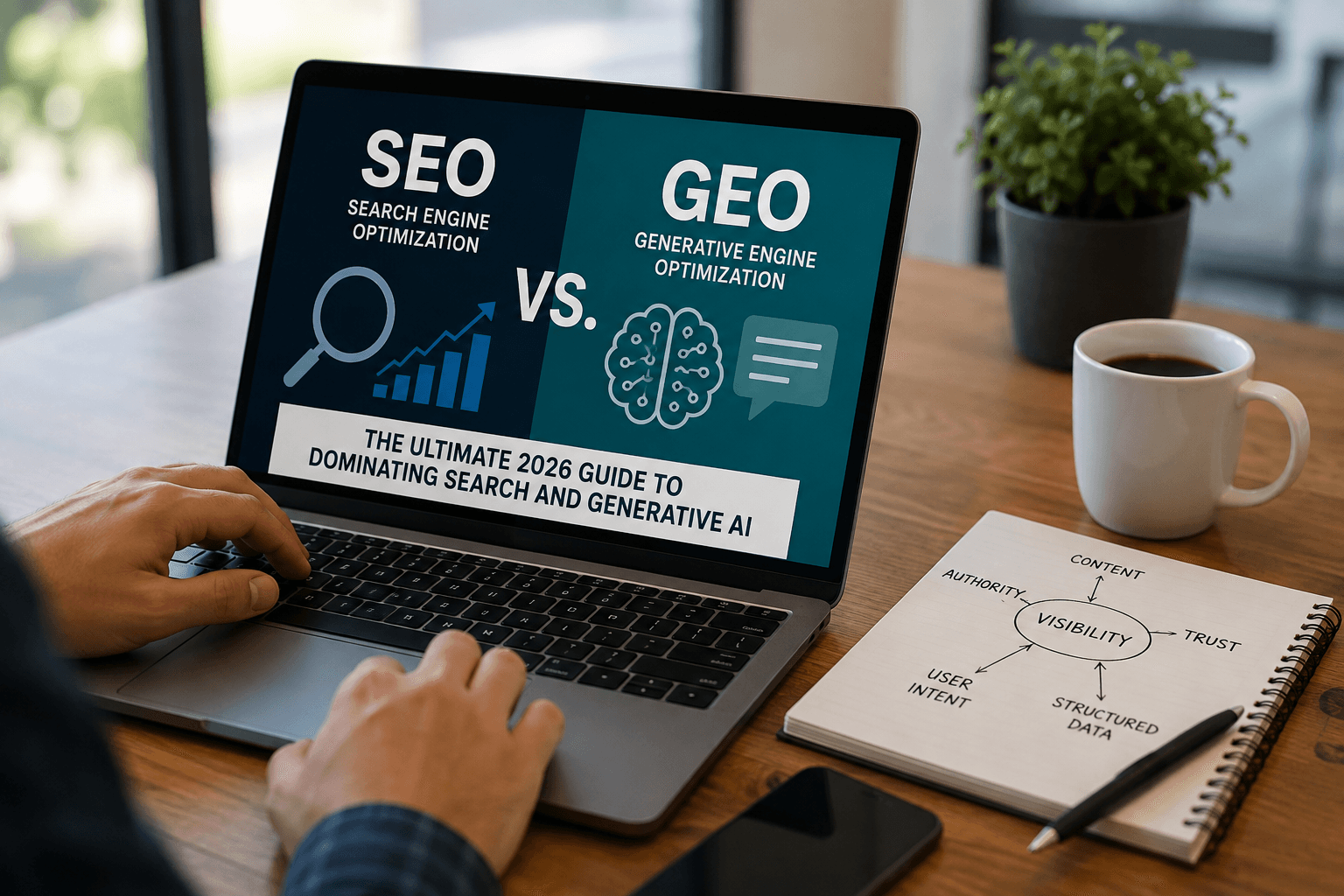
Table of Contents
The era of the “ten blue links” is fading. For two decades, search engine optimization was defined by keywords, backlinks, and crawlers. Today, the landscape has shifted to an ecosystem dominated by Large Language Models (LLMs) and generative search experiences. In 2026, dominance requires a dual strategy: integrating traditional Search Engine Optimization (SEO) with Generative Engine Optimization (GEO). This is not a competition between two disciplines; it is the birth of a unified visibility model essential for any brand aiming to thrive in the age of AI-generated answers.
The Great Shift: From Keyword Matching to Generative Understanding
Why 2026 Marks the End of “Search as We Knew It”
The transition from index-based search to generative search is fundamental. Search engines are no longer just directories; they are reasoning agents. Users no longer want to browse a list of links—they want immediate, synthesized resolutions. This change in search behavior demands that businesses provide clear, authoritative answers, not just keyword-heavy pages designed for crawlers.
Defining the Players: Search Engine Optimization (SEO) vs. Generative Engine Optimization (GEO)
 While SEO focuses on traditional ranking factors, GEO optimizes for AI ‘answerability.’ Combining both creates a unified visibility strategy.
SEO focuses on technical accessibility and site authority to win placement in organic search results. GEO, conversely, focuses on “answerability.” It ensures that AI systems like Gemini or Claude can easily parse your content to generate accurate, source-backed responses. Together, they form a comprehensive strategy for modern market dominance.
The Rise of the “Answer Engine” and the Zero-Click Reality
As generative engines become the primary interface for users, “zero-click” interactions are becoming the standard. When a user asks a question, the AI provides the answer directly. If your brand is not the cited source, you lose the interaction. Success now means becoming the preferred data point for AI retrieval.
Understanding the Ecosystem: How Generative Engines Think
Beyond the Crawler: How Large Language Models (LLMs) Process Information
LLMs are probabilistic engines that process vast datasets to predict the most helpful response. Unlike traditional crawlers that prioritize page rank, LLMs prioritize information density and structural clarity. Your content strategy must shift toward providing “source material” that these models find reliable.
The Role of Gemini, ChatGPT, Perplexity, and Claude in Modern Search
Each AI system acts as a distinct knowledge node. Perplexity focuses on real-time citations, while Claude and ChatGPT offer conversational depth. Your visibility depends on appearing across these diverse knowledge sources as a verified, authoritative entity.
AI-Powered Search Experiences: Decoding Google’s AI Overviews
Google’s AI Overviews serve as the bridge between traditional search and generative intelligence. These experiences synthesize information from various high-authority sources. To appear here, your content must be structured, succinct, and verified by cross-referencing markers.
The Endless Customers System™: A Unified Approach to Modern Visibility
Why You Can’t Choose Between SEO and GEO
Treating SEO and GEO as silos is a critical failure. SEO provides the technical foundation—the crawlability that allows bots to find you—while GEO provides the intelligence that makes you useful. One cannot exist effectively without the other.
Moving from Content Silos to a Unified Search Presence
Unified presence requires mapping your content to the entire user journey. From the top-of-funnel awareness generated by LLM responses to the bottom-of-funnel technical search queries, your brand messaging must be consistent and interconnected.
Building a Content Marketing Strategy That Feeds Both Algorithms and Humans
Prioritize high-value, structured content. Move away from generic keyword stuffing and toward intent-based problem solving. If your content answers a specific user question effectively, it becomes the training data of choice for AI systems.
The Technical Foundation: Building Your “Source of Truth”
Structured Data and Schema Markup: The Language of AI Systems
Schema markup is how you speak to machines. By implementing robust FAQ schema and entity-based structured data, you provide AI models with the context they need to categorize your brand accurately. It is the shortest path to becoming an “answer.”
Leveraging Product Information Management (PIM) for Data Accuracy
For e-commerce, a PIM is non-negotiable. Ensuring that your product specifications are centralized and accurate prevents the propagation of misinformation, which is the quickest way to lose trust with AI algorithms.
The Importance of a Centralized Product Information Strategy for E-commerce
Consistency across channels builds authority. When an AI checks your data, it looks for consensus. A centralized strategy ensures that your pricing, features, and availability are identical, whether the user is on your site or an AI platform.
Entity Graphs and Knowledge Graphs: Becoming a Recognized “Thing” in the Eyes of AI
You must transition from a website to an entity. By linking your brand to relevant topics, industries, and locations via knowledge graphs, you establish a footprint that AI systems can reliably track and trust.
Content Strategy for the Generative Era
Answer Engine Optimization (AEO): Crafting Content for Direct Responses
AEO is the tactical application of GEO. It involves creating content that explicitly addresses questions. Start with a direct answer, then provide the supporting detail, ensuring the information is easily extractable for AI summaries.
The Power of FAQs and Structured Content in Securing AI Mentions
FAQs are the perfect vehicle for AEO. They align with the natural language patterns of voice assistants and AI prompts. By embedding clear questions and concise answers in your pages, you increase the likelihood of being selected as a primary source.
Shifting Keyword Research to Intent-Based Problem Solving
Move away from “volume” metrics. Focus on the questions your clients are actually asking. Use sentiment analysis and customer support data to identify the pain points that search engines—and now AI systems—are trying to solve.
Designing Content Ecosystems That Support the User Journey
Every piece of content should lead the user to the next logical step. Create a connected web of information that encourages deep-dive research, establishing your brand as the ultimate authority on the topic.
Trust as the Ultimate Ranking Factor: E-E-A-T and Verification
Why Trust Signals Matter More in an AI-Generated World
AI models are prone to “hallucinations.” To mitigate this, developers prioritize sources with high Experience, Expertise, Authoritativeness, and Trust (E-E-A-T). Trust is your primary competitive advantage in a crowded market.
Building Authority Through Brand Mentions and High-Quality Backlinks
Backlinks remain vital, but brand mentions in high-authority journals and industry reports now carry more weight. These signals verify your expertise across the broader web, proving to AI that you are a credible source.
Verification Signals: How AI Cross-References Your Information for Accuracy
AI models cross-reference data points to ensure validity. If your site contradicts known industry facts or lacks corroboration from other trusted sources, your ranking potential drops significantly. Keep your information updated, verifiable, and evidence-based.
Local Search and GEO: Dominating the Immediate Vicinity
Optimizing Your Google Business Profile for AI Retrieval
Your Google Business Profile is the bedrock of local GEO. Ensure every detail—address, hours, and attributes—is perfectly aligned with your website. This consistency makes it easier for AI to provide accurate answers for location-based intent.
Local Citation Building and NAP Consistency in 2026
NAP (Name, Address, Phone) consistency across the internet acts as a signal of legitimacy. Local citations serve as “geographical backlinks,” confirming to AI that your business is a stable, reliable entity within a specific community.
Conclusion
The 2026 search environment is defined by the marriage of technical optimization and generative precision. By mastering both SEO and GEO, you ensure that your brand is not only visible to the crawlers of the past but also a central source of truth for the AI systems of the future. The imperative is clear: stop competing for clicks and start competing for authority. By implementing structured data, maintaining a rigorous source of truth, and building verifiable trust signals, you create an “Endless Customers System™” that transcends shifting algorithms. Success now rests on your ability to synthesize information for the machines that interpret the world for your customers. Start by auditing your schema, refining your answers, and aligning your brand identity as a verifiable entity. The future of search is here—and it rewards those who prioritize accuracy and user intent above all else.
Get real time update about this category directly on your device, subscribe now.