Nitin Tayal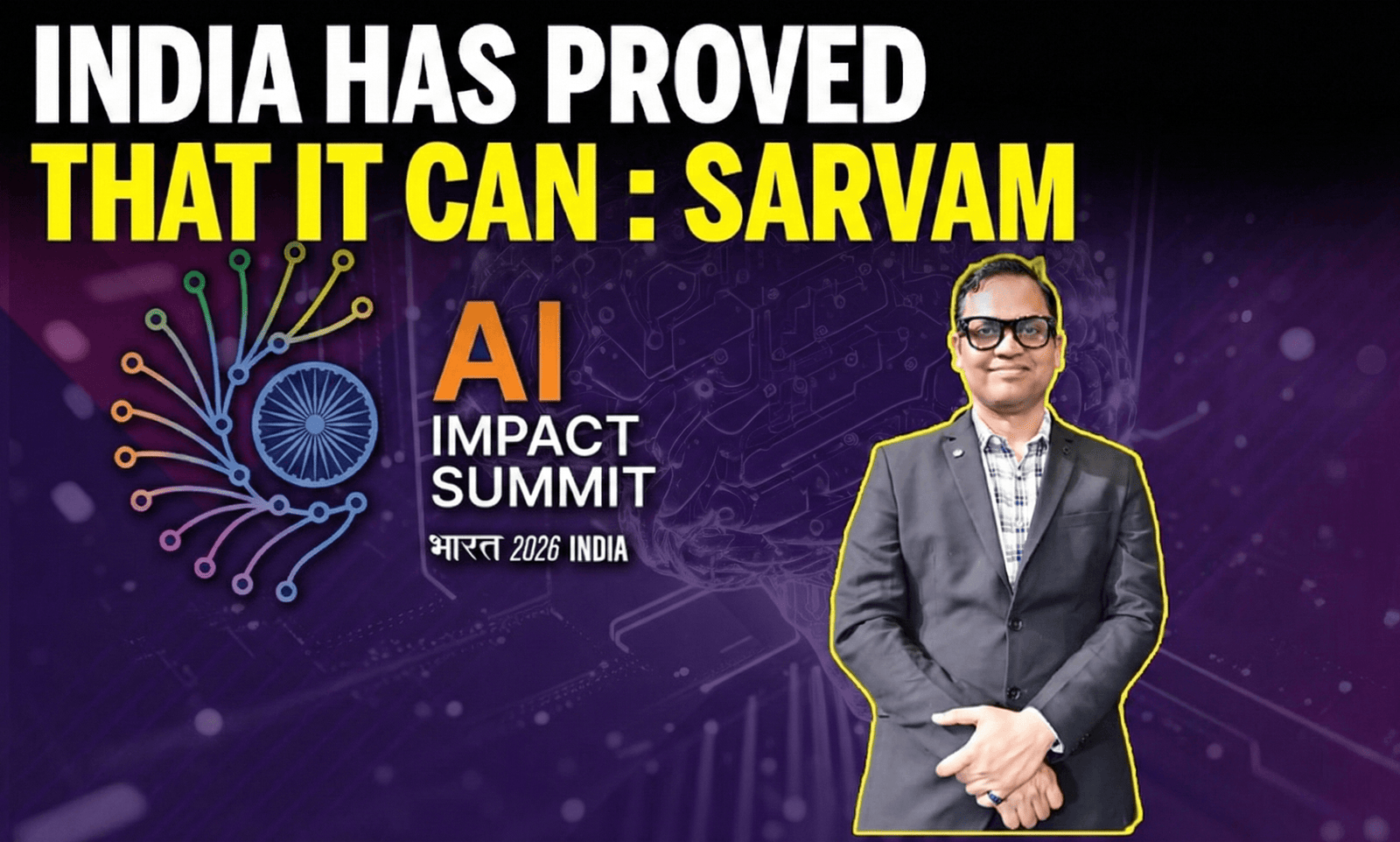
India has been floating around this question for a while now. Are we just “adopting AI” or are we actually building it, at scale, for our own constraints, languages, budgets, and public systems?
At the India AI Impact Summit 2026, the vibe shifted a bit. Less conceptual. More, here’s the model, here’s the stack, here’s what it runs on, here’s who it’s for. And in the middle of all that, India effectively put three sovereign AI models in the spotlight.
Not three demos. Three actual foundation style models (or near foundation, depending on how you define it) being positioned for real deployment.
This matters because India has climbed into the top 3 in global AI competitiveness in the 2023 to 2025 window. But it still ranks behind the US and China on the heavy stuff: elite AI talent concentration, cutting edge research output, frontier labs, startup valuations, and the total economic impact captured so far. So the summit wasn’t just a chest thump. It was a “fine, here’s our lane” moment.
Table of Contents
The headline: three sovereign AI models, each aiming at a different “India gap”
1) Sarvam AI: two MoE language models (30B and 105B parameters)

Star of the show !!, Sarvam AI unveiled 30B and 105B parameter language models trained under the IndiaAI Mission. Built from scratch these were positioned as large, serious models, but with an architecture choice that’s becoming the practical answer to cost and scale.
Both models are based on MoE (Mixture of Experts) architecture, where only a small part of the model is activated per token. That “activate a subset” approach is a big reason MoE has become the default talking point after DeepSeek’s R1 reasoning model story went viral: reported to be built at roughly a $6M cost compared to the often cited $100M class costs associated with training something like GPT 4. Different projects, different assumptions, not apples to apples. Still, the direction is clear. MoE made people believe again that the cost curve can bend.
Sarvam also introduced two platform pieces around those models:
- Pravah, described as a “token factory” for industrial scale AI usage. The phrasing is telling. They are trying to solve the boring part: throughput, reliability, predictable unit economics. The stuff enterprises and government departments care about more than benchmark screenshots.
- Indus, a chatbot for web and mobile users with emphasis on Indian languages. Not just English plus Hindi. The whole point is broad Indic coverage, and a product wrapper that can actually reach non technical users.
One thing that came up in discussions around Sarvam is openness. BharatGen has been more explicit publicly about documentation and post training workflows. Sarvam’s full training datasets or code release is not clearly established from what’s been shared publicly so far, and that creates a slightly different trust and ecosystem dynamic. Not a moral judgment, just a practical note. In sovereign AI, “can developers build on it” becomes as important as “can it answer questions.”
The all-new Sarvam is here.
— Sarvam (@SarvamAI) February 10, 2026
Designed for all of India.https://t.co/O78H03Jcki pic.twitter.com/zxtycbcDAu
2) BharatGen: Param 2 (17B parameters) aimed at public systems and enterprise workflows

BharatGen launched Param 2, a 17B parameter model, and the pitch was very use case forward: governance, healthcare, education, agriculture, plus enterprise usage.
This is where India’s AI strategy looks most distinct. Instead of trying to win the global general purpose chatbot race, a lot of Indian players are leaning into applied systems that fill India specific gaps. Think forms, schemes, eligibility, hospital intake, crop advisories, classroom content, local language interfaces, and the messiness of real world workflows.
BharatGen also leaned into transparency in a way that stood out. They have publicly shared documentation and post training workflows through Hugging Face repositories. That does two things at once. It builds credibility with developers and researchers, and it makes it easier for other teams to fine tune and deploy without waiting for a vendor relationship.
Like Sarvam, Param 2 is also based on MoE. Again, not because MoE is trendy, but because it’s one of the few ways to make larger capability accessible without paying for full dense compute on every token.
3) Gnani.ai: Inya VoiceOS with Vachana STT and TTS

Gnani.ai showcased Inya VoiceOS, an integrated voice operating system combining Vachana speech-to-text (STT) and text-to-speech (TTS) technologies. This stack is designed to enable seamless, natural language interactions across India’s diverse linguistic landscape, aiming at sectors like governance, healthcare, education, and agriculture.
Gnani.ai’s approach highlights the importance of robust speech interfaces in real-world workflows where typing or reading may be barriers. By focusing on local languages and dialects, they are enabling digital accessibility for millions who are underserved by conventional text-based AI systems.
This focus on voice technology aligns with the broader summit theme that impactful AI solutions do not have to be large-scale general models; instead, domain-specific, language-focused stacks provide practical value. These solutions are often more cost-effective to deploy and easier to integrate into existing services, thereby accelerating adoption in India’s varied socio-economic contexts.
India’s Sovereign AI Brigade
| Organisation | Products / Platforms | Key Specifications | Primary Focus |
|---|---|---|---|
| Sarvam | Sarvam 30B | 30 Bn parameters; 32K token context window | Multilingual, real-time conversation, instruction-following with reasoning |
| Sarvam | Sarvam 105B | 105 Bn parameters; 128K token context window | Enterprise-grade deployments, complex multi-step workflows |
| Sarvam | Indus | Web and mobile chatbot interface | Consumer and business-facing conversational AI |
| BharatGen | Param 2 | 17 Bn parameters | Multilingual public-good model trained on 22 Indian languages |
| Tech Mahindra | The Indus Project | 8 Bn parameters; Hindi-first LLM | Education use cases: adaptive tutoring, vernacular learning tools |
| Gnani.ai | Vachana STT | Speech-to-text model under Inya VoiceOS stack | Optimised for Indic languages; deployed entirely in Indian data centres |
| Gnani.ai | Vachana TTS | Text-to-speech model under Inya VoiceOS stack | Optimised for Indic languages; deployed entirely in Indian data centres |
| Fractal | Vaidya.ai | Second-generation health reasoning model | Healthcare workflows: emergency assistance, symptom checking, patient support |
It wasn’t just models. Startups showed the “stack” thinking
One thing I liked about the summit is that it didn’t pretend a model alone solves anything. A lot of the action was in speech, tooling, and deployment layers.
The headline: three sov
ereign AI models, each aiming at a different “India gap”,
- Sarvam AI: two MoE language models (30B and 105B parameters),
- BharatGen: Param 2 (17B parameters) aimed at public systems and enterprise workflows,
- Gnani.ai: Inya VoiceOS with Vachana STT and Vachana TTS for Indic languages,
It wasn’t just models. Startups showed the “stack” thinking, Gnani.ai introduced Vachana STT (speech to text) and Vachana TTS (text to speech) under the Inya VoiceOS stack, aimed at Indic languages. If you’ve built anything for India, you learn this fast: voice is not a “feature,” it’s sometimes the interface. Especially outside the metro English first context. Speech models that handle accent diversity, noisy environments, code switching, and multiple scripts are a big deal. And they’re also a moat.
Sarvam AI utilizes MoE architecture to balance cost and scalability by deploying mixture of experts models with 30B and 105B parameters, enabling efficient handling of diverse language demands.
BharatGen takes a focused approach by targeting public systems and enterprise workflows with its 17B parameter Param 2 model, aiming for practical deployments in government and business sectors.
Gnani.ai’s Inya VoiceOS stack emphasizes speech technologies tailored for Indic languages, recognizing that voice often serves as the primary interface in non-metro areas. Their Vachana STT and TTS handle complexities like accent variation, noisy environments, code-switching, and multiple scripts—creating a robust foundation for vernacular digital experiences.
If you look closely, these three models collectively address India’s linguistic diversity from different angles: large-scale language processing (Sarvam), domain-specific enterprise applications (BharatGen), and voice-first vernacular interaction (Gnani.ai).
This layered approach reflects the summit’s broader message: sovereign AI is not just about building massive models but assembling adaptable stacks that solve real problems in local contexts.
Get real time update about this category directly on your device, subscribe now.