Nitin Tayal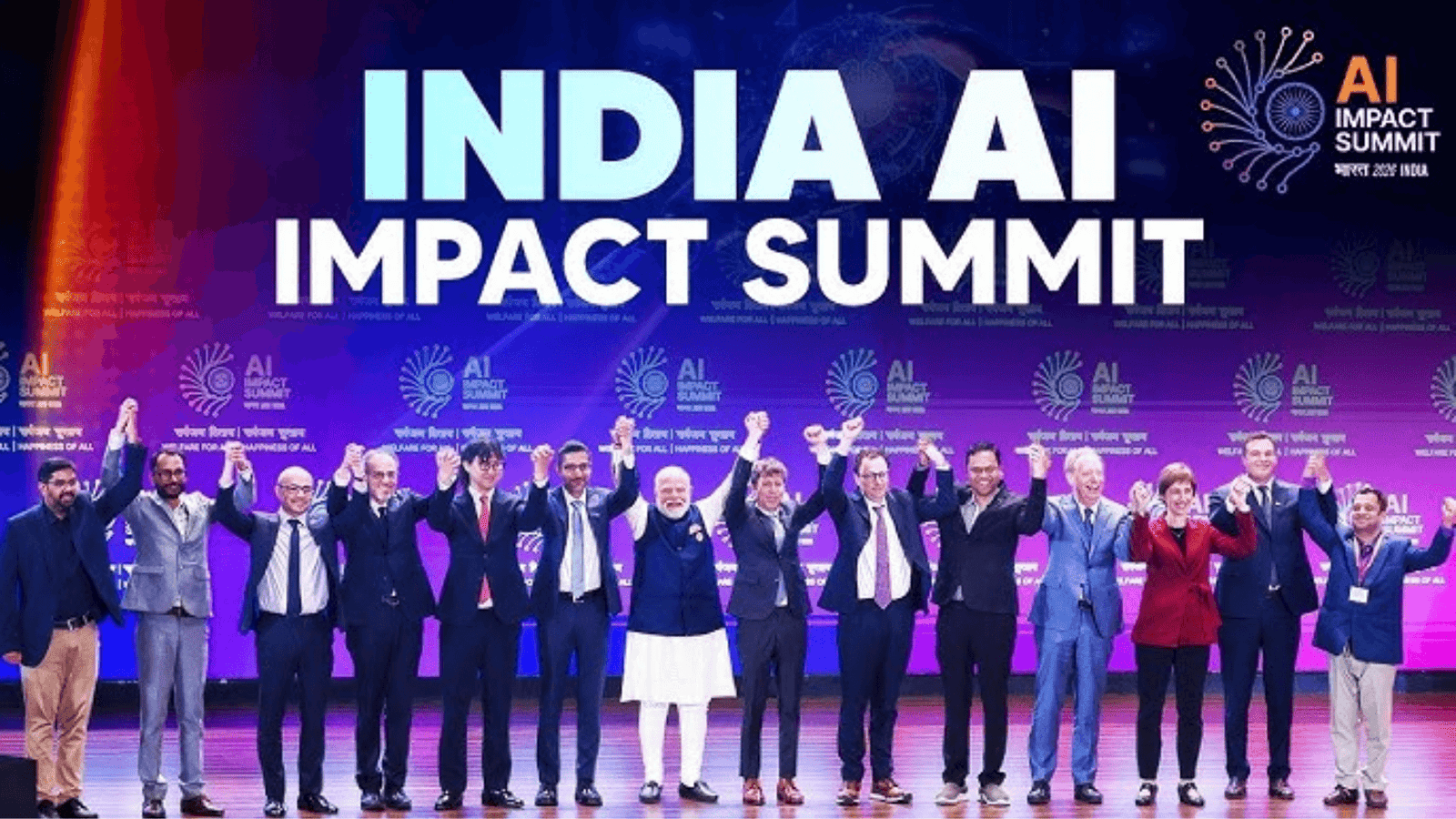
India just hosted a 4 day AI Impact Summit that felt less like a conference and more like a hard reset on where the country wants to sit in the AI world.
Big Tech, major frontier labs, Indian conglomerates, heads of state. And an audience scale that is kind of wild. Organizers said they were expecting around 250,000 visitors across the four days.
If you missed it, here’s the straight factual rundown of the announcements and the numbers that mattered.
AI for People, Planet and Progress.
— Randhir Jaiswal (@MEAIndia) February 12, 2026
The upcoming India-AI Impact Summit is the first-ever global AI Summit to be hosted in the Global South.
The theme of this summit is ‘Sarvajan Hitaya, Sarvajan Sukhaya – Welfare for All, Happiness of All' and is based on 3 sutras or guiding… pic.twitter.com/uQmeMartOz
Table of Contents
Who showed up (and why that matters)
The headline attendee list was basically a map of current AI power.
Alphabet CEO Sundar Pichai, OpenAI CEO Sam Altman, Anthropic CEO Dario Amodei, Google DeepMind CEO Demis Hassabis, and Reliance Chairman Mukesh Ambani were all reported to be attending. The presence of the labs plus India’s biggest capital allocators made the summit feel very compute and infrastructure heavy. Not just “AI awareness”.
OpenAI CEO Sam Altman and Anthropic CEO Dario Amodei visibly declined to hold hands during a group photo at the India AI Impact Summit, even as other leaders on stage linked arms for the ceremonial shot pic.twitter.com/J1eGShSkiK
— Reuters (@Reuters) February 19, 2026
India’s government money. $1.1B state backed VC fund
India earmarked $1.1B for a state backed venture capital fund investing in AI and advanced manufacturing startups.
That is one of the cleanest signals from the summit. The government is not only talking about adoption. It is also explicitly funding the supply side. New companies, hardware adjacent plays, deep tech, the stuff that needs patient capital.
New Delhi AI declaration signed by 88+ countries and orgs
India said over 88 countries and organizations signed a New Delhi AI declaration focused on using AI for social and economic good.
Also, India joined the Pax Silica group led by the U.S., described as a smooth supply chain network for AI infrastructure materials. Less glamorous than models and chatbots, but it is the type of thing that becomes decisive once everyone starts competing for the same chips, server components, power equipment, and cooling gear.
From Bharat, a global commitment to scaling AI responsibly. 🇮🇳 pic.twitter.com/yuFqY0ibaE
— Ashwini Vaishnaw (@AshwiniVaishnaw) February 19, 2026
OpenAI’s India numbers. 100M+ weekly active users and the “student” story
Sam Altman shared a couple of India usage stats that were repeated all over the summit coverage:
- India has more than 100 million weekly active ChatGPT users, second only to the United States.
- India has the most ChatGPT students.
- OpenAI also said 18 to 24 year old users drive nearly 50% of ChatGPT usage in India.
Whether you like ChatGPT or not, those numbers matter because they explain why every major AI lab now treats India as a primary market, not “later”.
Altman also addressed the common criticism around AI’s environmental footprint. He dismissed concerns about AI water usage in the way it is often framed, acknowledged there have been data center cooling issues historically, and called some arguments about ChatGPT’s power consumption “unfair”.
OpenAI to open offices in Bengaluru and Mumbai. Tata partnership for 100MW compute (scaling to 1GW)
OpenAI announced plans to open offices in Bengaluru and Mumbai.
The other part was bigger. OpenAI announced a partnership with the Tata group to deploy 100MW of compute in India, with a stated path to scale to 1GW.
A gigawatt is not a press release number. If that scale actually gets built and provisioned, it puts India into a different category in the global compute map.
India’s infrastructure push. Targeting $200B+ investment in two years
India said it aims to attract more than $200B in AI infrastructure investment in the next two years.
This lines up with the vibe of the whole summit. Less “here’s a cool model demo” and more “here’s how many GPUs, how many megawatts, and which industrial groups are committing capital”.
Blackstone takes majority stake in Neysa. $600M equity, plus $600M debt, 20k+ GPUs planned
Blackstone acquired a majority stake in Indian AI startup Neysa as part of a $600M equity fundraise.
On top of that, Neysa reportedly plans a $600M debt raise and a deployment plan of 20,000+ GPUs.
Private equity moving this aggressively into GPU buildouts is a signal that “AI infra” in India is becoming a real asset class, not just venture speculation.
Adani’s long horizon bet. $100B for renewable powered AI data centers by 2035
Adani announced an allocation of $100B for building renewable energy powered AI data centers in India by 2035.
The statement also included an expectation of an additional $150B of investment in adjacent layers, including:
- server manufacturing
- advanced electrical infrastructure
- sovereign cloud platforms
- supporting industries
Again, these are huge long timeline numbers. But they fit the summit’s main theme. Compute is industrial policy now.
AMD and TCS partner on rack scale AI infrastructure (Helios)
AMD announced a partnership with Tata Consultancy Services (TCS) to develop rack scale AI infrastructure based on AMD’s Helios platform.
Not a consumer headline, but relevant if India wants to build and operate serious AI stacks domestically, especially for large enterprises and government workloads.
UAE’s G42 and Cerebras bring 8 exaflops of compute to India (supercomputer effort)
Another major compute announcement. UAE’s G42 teamed up with Cerebras to deploy 8 exaflops of compute in India via a supercomputer initiative.
The effort also mentioned MBZUAI and C-DAC involvement.
This is one of those announcements that can be misunderstood because “exaflops” gets thrown around. But at minimum, it signals international capital and non NVIDIA compute architectures are also trying to establish a footprint in India.
Anthropic opens first office in Bengaluru. Infosys partnership and a Center of Excellence
Anthropic announced its first office in Bengaluru.
Anthropic also partnered with Infosys to deploy Claude models and tools in Indian enterprises, via an Anthropic Center of Excellence.
The practical implication is distribution. Infosys has enterprise reach. Anthropic has models. Together they are trying to make Claude a default option inside Indian corporate stacks.
Cartesia partners with Blue Machines for voice with local data residency
Cartesia teamed up with India based orchestrator Blue Machines for voice solutions, with an emphasis on local data residency.
That detail is important because more regulated sectors and many government linked deployments in India tend to demand local storage and processing. Voice is also where language and accent diversity makes “generic global” systems perform badly.
Cohere Labs launches multilingual models supporting 70+ languages, tuned by region
Cohere Labs announced multilingual models supporting 70+ languages, tuned to specific regions.
No fluff here. Regional tuning is basically an admission that language coverage is not just “add more tokens”. You need locale specific data, evaluation, and product constraints.
First Indian model launches and product announcements. A quick but complete list
Upto 12 Indian LLM Models launched by Ai startups atleast 3 of them are completely built from scratch Sarvam AI, BharatGPT, Gnani AI
A bunch of India first AI product and model news landed around the summit. Here are the ones that were specifically called out.
Sarvam: Kaze smart glasses tease, plus a stack of speech and vision models
Sarvam teased smart glasses called Sarvam Kaze.
Sarvam also released models covering:
- dubbing
- speech to text
- text to speech
- vision models for OCR
Sarvam AI: 30B and Sarvam 105B AI models
Sarvam released open sourced models Sarvam 30B and Sarvam 105B, and announced partnerships with Qualcomm, HMD, and Bosch for on device deployment.
Sarvam also launched a ChatGPT competitor called Indus, positioned as multilingual across Indian languages.
BharatGen: Param 2 model (17B) across 22 languages
BharatGen released a 17B parameter model, Param 2, across 22 languages.
Gnani: Vachana zero shot voice cloning TTS (12 languages)
Gnani released Vachana, a zero shot voice cloning text to speech model supporting 12 languages.
Tech Mahindra: 8B Hindi oriented model for education
Tech Mahindra released an 8B parameter model focused on Hindi, aimed at educational use cases.
JioHotstar: conversational search using ChatGPT
JioHotstar announced it uses ChatGPT for conversational search.
This is a very specific and very real application. Discovery in large content libraries is a mess, especially across languages. Conversational search is one of the obvious early wins.
Emergent: hits $100M ARR, launches mobile app
Emergent said it reached $100M ARR and launched a mobile app.
India AI Impact Expo 2026 was a powerful convergence of ideas, innovation and intent.
— Narendra Modi (@narendramodi) February 17, 2026
It showcased the extraordinary potential of Indian talent in shaping the future of Artificial Intelligence for global good.
Above all, it reaffirmed our commitment to harnessing AI… pic.twitter.com/jfVWCP4BHh
Data center and power plumbing. C2i raises $15M for data center power solutions
Bengaluru based C2i raised $15M in a Series A round led by Peak XV, for a power solution for data centers.
This kind of announcement matters because “AI in India” is going to be constrained by very boring things. Power distribution, uptime, cooling, grid integration. Not inspiration.
Jobs, IT services, and the anxiety that kept surfacing
Not everything was celebratory. A thread running through the summit was job disruption and the fragility of the services model.
- HCL’s CEO said Indian IT companies are prioritizing profits over job creation, due to fears of AI disruption.
- Khosla Ventures founder Vinod Khosla warned that IT services and BPOs may almost completely disappear within five years due to AI.
- He suggested a counter move, that 250 million young Indians could sell AI based products and services globally.
Even if you don’t buy the five year timeline, the fact this was said loudly at this summit tells you the concern is now mainstream, not a niche prediction.
The summit, boiled down
If you stitch all of this together, you get a clear picture.
India is pushing on three fronts at once.
- Infrastructure and compute. The money and megawatts. Tata and OpenAI’s 100MW to 1GW plan, Adani’s $100B data center allocation, G42 and Cerebras talking 8 exaflops, Blackstone buying into Neysa with GPU deployment plans.
- Distribution into enterprises. Anthropic plus Infosys, AMD plus TCS, and the broader effort to make AI adoption feel operational, not experimental.
- Indian language and on device AI. Sarvam, BharatGen, Gnani, Tech Mahindra, and the product layer like JioHotstar search.
And over it all, the political layer. The New Delhi AI declaration, the 88+ signatories, and the supply chain coordination through Pax Silica.
That’s basically every important announcement from the India AI Impact Summit, without the fluff.
Get real time update about this category directly on your device, subscribe now.