Barsha Chowdhury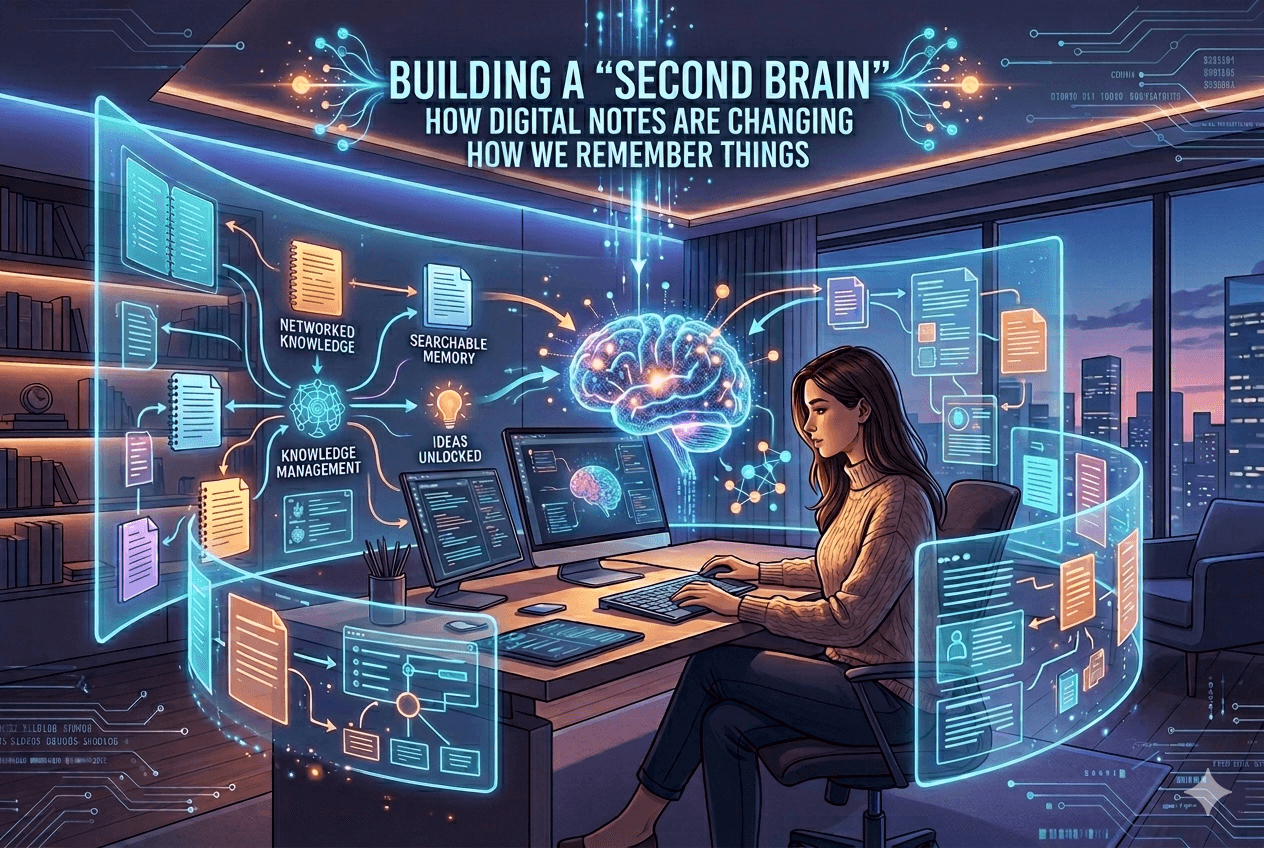
Every day, the average person consumes massive amounts of information -emails, videos, articles, meetings, lectures, podcasts, and social media posts. Yet most of that information disappears from memory within days.
Research by German psychologist Hermann Ebbinghaus showed that humans forget nearly 50% of newly learned information within an hour and up to 70% within 24 hours without reinforcement.
This phenomenon, known as the “forgetting curve,” continues to influence modern learning science.At the same time, our digital lives have become increasingly overwhelming.
According to a 2024 report by Statista, the world generates over 402 million terabytes of data every single day.
For students and professionals, remembering important insights has become harder than ever.This is where the concept of a Second brain becomes powerful.
A second brain is a trusted digital system that stores, organizes, and retrieves ideas so your biological brain does not have to remember everything alone.
Through digital note taking and personal knowledge management systems, people are changing how they learn, think, and work
.In this guide, you will learn:
- What a second brain actually means
- Why digital notes improve memory and productivity
- How to build a second brain step-by-step
- The role of the Zettelkasten method
- The best tools and workflows for beginners
Table of Contents
What Is a Second Brain?
The term “second brain” became widely popular through productivity expert Tiago Forte and his framework for organizing digital knowledge.
A second brain is essentially:
A digital extension of your memory designed to capture, organize, and retrieve information efficiently.
Instead of relying entirely on memory, people use:
- Note-taking apps
- Cloud storage
- Linked knowledge systems
- AI search tools
- Digital databases
The goal is not to remember more manually. The goal is to remember smarter.
A second brain can include:
- Class notes
- Book highlights
- Meeting summaries
- Business ideas
- Research
- Creative inspiration
- Travel plans
- Journals
Modern knowledge workers increasingly depend on these systems because human attention is limited.
Why Humans Forget Information So Quickly
Human memory was never designed for the internet age.
According to cognitive load theory developed by psychologist John Sweller, the brain has limited working memory capacity. When too much information enters at once, retention decreases dramatically.
Several factors contribute to forgetting:
- Information overload
- Multitasking
- Constant notifications
- Stress
- Lack of revision
- Passive consumption
A 2023 study published in Nature Reviews Psychology found that excessive digital switching reduces concentration and weakens long-term memory formation.
This explains why many people:
- Save articles but never revisit them
- Forget meeting insights
- Lose track of ideas
- Struggle with productivity
Digital note taking helps solve this problem by externalizing memory.
The Rise of Digital Note Taking
Traditional notebooks still have value, but digital note taking has transformed personal productivity.
According to Grand View Research, the global note-taking app market is expected to grow significantly through 2030 due to increased remote work, online education, and AI integration.
Modern digital notes offer advantages such as:
- Instant search
- Cloud syncing
- Cross-device access
- Hyperlinking
- Multimedia integration
- AI-powered organization
Popular apps include:
- Notion
- Obsidian
- Evernote
- OneNote
- Apple Notes
These tools are no longer just storage systems. They are becoming thinking systems.
Benefits of Building a Second Brain
1. Reduced Mental Overload
When ideas are safely stored externally, the brain experiences less cognitive stress.
Instead of trying to remember everything, you can focus on:
- Creativity
- Analysis
- Decision-making
2. Faster Learning
Students and professionals who revisit connected notes retain information more effectively.
Research from the University of California suggests spaced retrieval and active recall improve long-term retention significantly compared to passive rereading.
3. Better Creativity
Creative thinking often emerges through connections between unrelated ideas.
A second brain allows you to:
- Link concepts
- Rediscover forgotten insights
- Combine ideas across subjects
This process is central to innovation.
4. Improved Productivity
Searching through scattered screenshots, tabs, or notebooks wastes time.
A structured digital system improves:
- Task management
- Project execution
- Research efficiency
5. Long-Term Knowledge Growth
Over time, your digital notes become a personal knowledge library.
Instead of restarting from zero, you continuously build on previous learning.
How to Build a Second Brain
Step 1: Capture Information
The first step is collecting valuable information quickly.
Capture:
- Quotes
- Ideas
- Lecture notes
- Meeting summaries
- Web articles
- Voice memos
Avoid capturing everything. Focus only on information that:
- Feels useful
- Sparks curiosity
- Solves problems
- Supports goals
Step 2: Organize Your Notes
One popular framework is PARA:
- Projects
- Areas
- Resources
- Archives
This system helps reduce clutter and improve retrieval.
Example:
| Category | Example |
| Projects | Semester assignment |
| Areas | Health , finance |
| Resources | Psychology research |
| Archives | old completed work |
Step 3: Connect Ideas
This is where a second brain becomes powerful.
Instead of isolated notes, create linked knowledge.
For example:
- Link a productivity quote to a psychology concept
- Connect marketing ideas with behavioral science
- Relate lecture notes to real-world examples
This networked thinking improves understanding.
Step 4: Review Regularly
A second brain only works if revisited consistently.
Weekly reviews help:
- Refresh memory
- Remove clutter
- Strengthen learning
- Rediscover useful ideas
Even 15 minutes weekly can improve retention.
Step 5: Retrieve and Apply
Knowledge becomes valuable only when used.
Use your notes for:
- Writing
- Exams
- Business decisions
- Content creation
- Problem-solving
Application reinforces memory.
Personal Knowledge Management Explained
Personal knowledge management (PKM) refers to the process of collecting, organizing, and using information effectively.
It combines:
- Learning systems
- Information organization
- Productivity workflows
- Memory techniques
PKM has become increasingly important because modern professionals operate in information-heavy environments.
Knowledge workers now spend large portions of their day:
- Searching for information
- Reading messages
- Switching between apps
A structured PKM system reduces digital chaos
Understanding the Zettelkasten Method
The zettelkasten method originated from German sociologist Niklas Luhmann, who reportedly created over 90,000 interconnected notes during his career.
“Zettelkasten” means “slip box” in German.
The system works through:
- Atomic notes
- Linked ideas
- Cross-references
- Continuous connection-building
Instead of writing large summaries, users create small independent notes connected through links.
Example:
- One note about habit formation
- Another about dopamine
- Another about procrastination
Over time, relationships emerge naturally.
This method is now widely used in apps like Obsidian and Logseq.
Best Tools for Digital Note Taking
Notion
Best for:
- All-in-one organization
- Students
- Teams
Features:
- Databases
- Templates
- AI tools
- Collaboration
Obsidian
Best for:
- Linked thinking
- Zettelkasten workflows
Features:
- Graph view
- Markdown support
- Offline storage
Evernote
Best for:
- Web clipping
- Quick organization
Features:
- OCR search
- Document scanning
- Syncing
OneNote
Best for:
- Microsoft ecosystem users
Features:
- Freeform note layouts
- Integration with Office apps
Apple Notes
Best for:
- Simplicity
- Apple users
Features:
- Fast syncing
- Smart folders
- Easy accessibility
AI and the Future of Second Brains
Artificial intelligence is transforming digital note taking rapidly.
AI-powered systems now offer:
- Automatic summarization
- Smart tagging
- Semantic search
- Idea generation
- Meeting transcription
According to McKinsey’s 2024 AI report, generative AI could significantly improve knowledge-work productivity across industries.
However, experts warn that overdependence on AI-generated summaries may reduce deep thinking if users stop engaging critically with information.
The future of second brains will likely combine:
- Human creativity
- AI assistance
- Personalized learning systems
Common Mistakes to Avoid
Capturing Too Much
Information hoarding creates clutter.
Focus on quality over quantity.
Ignoring Organization
Random notes become digital junk quickly.
Use categories and linking systems consistently.
Never Reviewing Notes
Unreviewed notes become forgotten storage.
Build weekly review habits.
Tool Obsession
Many beginners waste time switching apps constantly.
The system matters more than the software.
Real-World Examples
Students
Students use second brains for:
- Lecture summaries
- Revision systems
- Research organization
Content Creators
Writers and creators store:
- Content ideas
- Research
- Quotes
- Scripts
This reduces creative blocks.
Professionals
Professionals use digital note taking for:
- Meeting records
- Project management
- Skill development
- Knowledge sharing
Frequently Asked Questions
1.What is a second brain?
A second brain is a digital system designed to store and organize information outside your biological memory.
2.How do I build a second brain?
Start by capturing useful information, organizing notes into categories, linking ideas, reviewing regularly, and applying knowledge practically.
3.Which app is best for digital note taking?
It depends on your needs:
- Notion for organization
- Obsidian for linked thinking
- OneNote for Microsoft users
4.What is personal knowledge management?
Personal knowledge management is the process of collecting, organizing, and using information effectively for learning and productivity.
5.What is the Zettelkasten method?
The zettelkasten method is a linked-note system that uses small interconnected notes to improve thinking and idea generation.
6.Is a second brain useful for students?
Absolutely. Students can organize lectures, revision notes, research papers, and assignments more efficiently.
Conclusion
In a world overloaded with information, building a Second brain is no longer just a productivity trend it is becoming a survival skill for learning and focused thinking.
Digital note taking systems help reduce mental overload, improve creativity, and strengthen long-term knowledge retention. Whether you are a student managing lectures, a creator organizing ideas, or a professional handling complex projects, a second brain can transform how you work and remember.
The key is not finding the perfect app.
The key is building a consistent system that helps you think clearly and retrieve knowledge when it matters most.Start small:
- Capture one useful idea daily
- Organize your notes weekly
- Connect related concepts
- Review and apply your knowledge
Over time, your second brain becomes one of your most valuable assets.
Call to Action
Have you started building your own second brain yet?
Share your favorite digital note taking app or productivity method in the comments. If this guide helped you, bookmark it and share it with someone struggling with information overload.
Get real time update about this category directly on your device, subscribe now.
Have any thoughts?
Share your reaction or leave a quick response — we’d love to hear what you think!
-
 0
0 - 0
- 0
- 0
- 0
- 0